Tutorial on the ceiling function, including graphing and evaluations, is presented.
Definition of the Ceiling Function
The ceiling function \( \lceil x \rceil \) (or \( \text{ceiling}(x) \)) is defined as the function that outputs the smallest integer greater than or equal to \( x \). Below is shown the graph of \( \text{ceiling}(x) \):
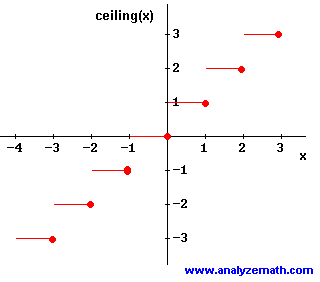
The domain of \( \text{ceiling}(x) \) is the set of all real numbers. The range of \( \text{ceiling}(x) \) is the set of all integers.
Evaluations and Examples
Evaluate \( \text{ceiling}(x) \) for various values of \( x \).
Example 1
Evaluate \( \text{ceiling}(1.5) \)
Solution
Example 2
Evaluate \( \text{ceiling}(0) \)
Solution
Example 3
Evaluate \( \text{ceiling}(2) \)
Solution
Example 4
Evaluate \( \text{ceiling}(-3) \)
Solution
Example 5
Evaluate \( \text{ceiling}(-1.5) \)