Definition and tutorial on the floor function. Examples on how to evaluate the floor function are presented.
Definition of the Floor Function
The floor function \(\lfloor x \rfloor\) (or \(\text{floor}(x)\)) is defined as the function that gives the highest integer less than or equal to \(x\). The graph of \(\text{floor}(x)\) is shown below:
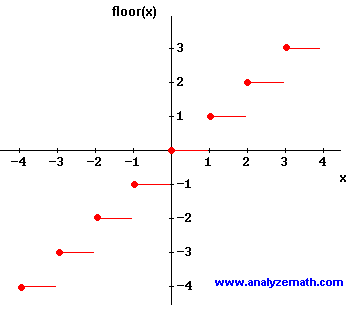
The domain of \(\text{floor}(x)\) is the set of all real numbers, while the range of \(\text{floor}(x)\) is the set of all integers.
Evaluations and Examples
Evaluate \(\text{floor}(x)\) for various values of \(x\).
Example 1
Evaluate \(\text{floor}(1.5)\)
Solution
\[ \text{floor}(1.5) = 1 \]
Example 2
Evaluate \(\text{floor}(0)\)
Solution
\[ \text{floor}(0) = 0 \]
Example 3
Evaluate \(\text{floor}(2)\)
Solution
\[ \text{floor}(2) = 2 \]
Example 4
Evaluate \(\text{floor}(-3)\)
Solution
\[ \text{floor}(-3) = -3 \]
Example 5
Evaluate \(\text{floor}(-1.5)\)
Solution
\[ \text{floor}(-1.5) = -2 \]