Parabola and Line Intersection Problem
In this algebra problem, we explore the intersection of a parabola and a line using their graphs. Problems like this are common in Algebra and Pre-Calculus, since they combine concepts of quadratic functions, linear functions, and inequalities.
Table of Contents
Problem Statement
The graphs of a parabola given by \( y = f(x) \) and a line given by \( y = g(x) \) are shown below. The parabola and the line intersect at points \( A \) and \( D \); where \( A \) is on the x-axis and has an x-coordinate equal to \( 2 \). Point \( V \) is the vertex of the parabola.
Based on the provided graph coordinates, the line also passes through \( C(-3, -5) \), and the vertex is at \( V(4, -4) \).
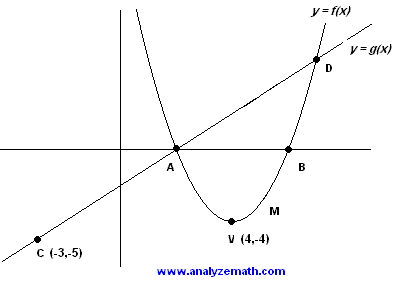
- Find the equation of the line \( g \) and write it in the form \( g(x) = mx + b \).
- Find the equation of the parabola \( f(x) \).
- Find the x-coordinate of point \( D \).
- Use the graph and the equations to solve the inequality \( f(x) \gt g(x) \).
Step-by-Step Solution
View Full Solution
Part (a): Equation of the line \( g \)
The line \( y = g(x) \) passes through the points \( C(-3, -5) \) and \( A(2, 0) \).
First, calculate the slope \( m \):
\[ m = \frac{0 - (-5)}{2 - (-3)} = \frac{5}{5} = 1 \]Next, use the point-slope form of the equation of a line:
\[ y - 0 = 1(x - 2) \]Which simplifies to:
\[ y = x - 2 \]Hence, the equation of the line is:
Part (b): Equation of the parabola \( f \)
The vertex of the parabola is known to be \( V(4, -4) \). The equation of the parabola in vertex form is given by:
\[ y = a(x - h)^2 + k \implies y = a(x - 4)^2 - 4 \]Point \( A(2, 0) \) is on the parabola. Substitute \( x = 2 \) and \( y = 0 \) into the equation to find \( a \):
\[ 0 = a(2 - 4)^2 - 4 \] \[ 0 = a(-2)^2 - 4 \] \[ 0 = 4a - 4 \implies 4a = 4 \implies a = 1 \]Hence, the equation of the parabola is given by:
Note: Expanding this gives \( f(x) = x^2 - 8x + 12 \).
Part (c): The x-coordinate of point \( D \)
The points of intersection are determined by setting \( f(x) \) equal to \( g(x) \):
\[ (x - 4)^2 - 4 = x - 2 \]Expand and simplify the equation:
\[ x^2 - 8x + 16 - 4 = x - 2 \] \[ x^2 - 8x + 12 = x - 2 \] \[ x^2 - 9x + 14 = 0 \]Factor the quadratic equation:
\[ (x - 2)(x - 7) = 0 \]This yields the solutions \( x = 2 \) and \( x = 7 \).
Since \( x = 2 \) is already known to be the x-coordinate of point \( A \), it follows that \( x = 7 \) is the x-coordinate of point \( D \).
Note: The y-coordinate of \( D \) is found by \( g(7) = 7 - 2 = 5 \).
Part (d): Solving the inequality \( f(x) \gt g(x) \)
Geometrically, \( f(x) \gt g(x) \) in the regions where the parabola is above the line.
- From the left side of the graph up to point \( A \) (where \( x = 2 \)), the parabola is above the line, so the interval \( (-\infty, 2) \) is part of the solution set.
- Similarly, from point \( D \) (where \( x = 7 \)) to the right side of the graph, the parabola is again above the line, providing the interval \( (7, +\infty) \).
Therefore, the complete solution set for the inequality \( f(x) \gt g(x) \) is given by the union of these intervals:
Verification of the Solution
Check 1 — Both intersection points satisfy both equations:
- At \( x = 2 \): \( f(2) = (2-4)^2 - 4 = 4 - 4 = 0 \); \( g(2) = 2 - 2 = 0 \). ✓
- At \( x = 7 \): \( f(7) = (7-4)^2 - 4 = 9 - 4 = 5 \); \( g(7) = 7 - 2 = 5 \). ✓
Check 2 — The vertex \( V(4, -4) \) is indeed on the parabola:
\( f(4) = (4-4)^2 - 4 = 0 - 4 = -4 \). ✓
Check 3 — The inequality holds in a sample test point:
Take \( x = 0 \) (which is in the interval \( (-\infty, 2) \)):
\( f(0) = (0-4)^2 - 4 = 16 - 4 = 12 \) and \( g(0) = 0 - 2 = -2 \). Since \( 12 \gt -2 \), the inequality holds. ✓
Take \( x = 5 \) (which is between 2 and 7, so should NOT be a solution):
\( f(5) = (5-4)^2 - 4 = 1 - 4 = -3 \) and \( g(5) = 5 - 2 = 3 \). Since \( -3 \lt 3 \), the inequality does NOT hold. ✓
Summary of Results
| Item | Result |
|---|---|
| Line equation \( g(x) \) | \( g(x) = x - 2 \) |
| Parabola equation \( f(x) \) | \( f(x) = (x-4)^2 - 4 = x^2 - 8x + 12 \) |
| Vertex of parabola | \( V(4, -4) \) |
| Intersection point A | \( A(2, 0) \) |
| Intersection point D | \( D(7, 5) \) |
| Solution to \( f(x) \gt g(x) \) | \( (-\infty, 2) \cup (7, +\infty) \) |
Key Concepts Reviewed
Skills Practiced in This Problem
- Slope of a line: \( m = \frac{y_2 - y_1}{x_2 - x_1} \) — used to find the slope of the line through two points.
- Point-slope form: \( y - y_1 = m(x - x_1) \) — used to write the equation of the line.
- Vertex form of a parabola: \( y = a(x-h)^2 + k \) — used to write the parabola equation given its vertex.
- Solving for a parameter: Substituting a known point into the vertex form to find \( a \).
- Solving systems of equations: Setting \( f(x) = g(x) \) and solving the resulting quadratic.
- Factoring quadratics: \( x^2 - 9x + 14 = (x-2)(x-7) \).
- Quadratic inequalities: Reading the solution from the graph and verifying algebraically.
- Interval notation: \( (-\infty, 2) \cup (7, +\infty) \).
Frequently Asked Questions
How do you find the equation of a parabola given its vertex and one point?
Use the vertex form \( y = a(x - h)^2 + k \), where \( (h, k) \) is the vertex. Substitute the coordinates of the known point into the equation to solve for \( a \). For example, with vertex \( (4, -4) \) and point \( (2, 0) \), \( 0 = a(2-4)^2 - 4 \) gives \( a = 1 \).
How do you find the intersection points of a parabola and a line?
Set the equation of the parabola equal to the equation of the line, then solve the resulting quadratic equation. For example, \( (x-4)^2 - 4 = x - 2 \) simplifies to \( x^2 - 9x + 14 = 0 \), which factors as \( (x-2)(x-7) = 0 \), giving intersection x-coordinates 2 and 7.
How do you solve the inequality \( f(x) \gt g(x) \) graphically?
Identify the x-values where the graph of \( f(x) \) lies above the graph of \( g(x) \). For a parabola opening upward intersected by a line at \( x = 2 \) and \( x = 7 \), the parabola is above the line for \( x \lt 2 \) and \( x \gt 7 \), so the solution is \( (-\infty, 2) \cup (7, +\infty) \).
What is the vertex form of a parabola?
The vertex form of a parabola is \( y = a(x - h)^2 + k \), where \( (h, k) \) is the vertex. The parameter \( a \) determines the direction and width of the parabola: if \( a \gt 0 \), it opens upward; if \( a \lt 0 \), it opens downward.
How do you determine whether a parabola opens upward or downward?
The sign of the leading coefficient \( a \) determines the direction. If \( a \gt 0 \), the parabola opens upward (concave up). If \( a \lt 0 \), the parabola opens downward (concave down). In this problem, \( a = 1 \), so the parabola opens upward.