Practice Questions
-
Area Ratios: The three circles \( C_1 \), \( C_2 \), and \( C_3 \) have their centers \( O_1 \), \( O_2 \), and \( O_3 \) on the line \( L \) and are all tangent at the same point. If the diameter of the largest circle is 20 units, what is the ratio of the area of the largest circle to the area of the smallest circle?

View Step-by-Step Solution
Step 1: Area of the largest circle (\( C_1 \))
- The diameter of circle \( C_1 \) is 20 units, so its radius (\( r_1 \)) is 10 units.
- Area \( A \) of circle \( C_1 \) = \( \pi(10)^2 = 100\pi \).
Step 2: Area of the smallest circle (\( C_3 \))
- Based on the diagram, the diameter of \( C_2 \) equals the radius of \( C_1 \) (10 units). So, \( r_2 = 5 \) units.
- The diameter of \( C_3 \) equals the radius of \( C_2 \) (5 units). So, the radius of \( C_3 \) (\( r_3 \)) is 2.5 units.
- Area \( B \) of circle \( C_3 \) = \( \pi(2.5)^2 \).
Step 3: Find the ratio
- \( \dfrac{A}{B} = \dfrac{\pi(10)^2}{\pi(2.5)^2} \)
- \( = \left(\dfrac{10}{2.5}\right)^2 = 4^2 = 16 \)
- The ratio is 16:1.
-
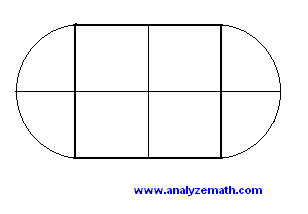
Compound Shapes: Mrs. Parkinson's garden is made up of 4 squares and 2 semicircles as shown below. Each small square has an area of 4 square meters. Find the total area of the garden.
View Step-by-Step Solution
Step 1: Area of the squares
- Total area of the 4 squares = \( 4 \times 4 = 16 \text{ m}^2 \).
Step 2: Find the dimensions of the semicircles
- The area of one small square is \( 4 \text{ m}^2 \), meaning its side length is \( \sqrt{4} = 2 \text{ m} \).
- The radius of each semicircle matches the side of the square, so \( r = 2 \text{ m} \).
Step 3: Calculate the total area
- The two semicircles combine to form one full circle.
- Area of the circle = \( \pi \times 2^2 = 4\pi \text{ m}^2 \).
- Total Area = \( 16 + 4\pi \approx 16 + 12.56 = \) \( 28.56 \text{ m}^2 \) (using \(\pi \approx 3.14\)).
-
Real-World Application: A water sprinkler can spray water at a maximum distance of 12 meters in all directions. What area of the garden can this sprinkler irrigate? Round your answer to the nearest square meter.
View Step-by-Step Solution
- One full rotation of the sprinkler irrigates a circular area with a radius of 12 meters.
- Area = \( \pi r^2 \)
- Area = \( \pi(12)^2 = 144\pi \)
- \( 144 \times 3.14159 \approx 452.389 \)
- The sprinkler can irrigate approximately 452 square meters.
-
Concentric Circles: A circular garden with a radius of 10 meters is surrounded by a walkway of width 1 meter. Find the area of the walkway (the shaded part).

View Step-by-Step Solution
- The walkway is enclosed between a smaller inner circle and a larger outer circle.
- Inner radius = 10 meters.
- Outer radius = \( 10 + 1 = 11 \) meters.
- Area of walkway = Area of Outer Circle - Area of Inner Circle
- Area = \( (\pi \times 11^2) - (\pi \times 10^2) \)
- Area = \( 121\pi - 100\pi \) = \( 21\pi \text{ m}^2 \)
-
Unit Cost Application: A circular pizza costs $19.99. What is the cost of 1 square centimeter if the diameter of the pizza is 36 cm?
View Step-by-Step Solution
- First, find the radius: \( 36 \div 2 = 18 \text{ cm} \).
- Calculate the total area: \( \pi \times 18^2 = 324\pi \approx 1017.87 \text{ cm}^2 \).
- Calculate the cost per square cm by dividing the total cost by the total area.
- \( \dfrac{19.99}{1017.87} \approx 0.0196 \text{ dollars} \)
- The cost is approximately 2 cents per square centimeter.
-
Working Backwards from Area: How much fencing is needed for the Robinsons' circular flower garden that has an area of 5 square meters? (Round your answer to the nearest meter).
View Step-by-Step Solution
The fencing goes around the outside, so we need to find the circumference. First, we must find the radius.
- \( \pi \times r^2 = 5 \)
- \( r^2 = \dfrac{5}{\pi} \)
- \( r = \sqrt{\dfrac{5}{\pi}} \approx 1.26 \text{ meters} \)
Now, calculate the circumference:
- \( C = 2\pi r \)
- \( C = 2 \times \pi \times 1.26 \approx 7.92 \text{ meters} \)
- Approximately 8 meters of fencing is needed.
-
Percentage Increase: The radius of a circular disk is increased by 20%. What is the percent increase in the area of the disk?
View Step-by-Step Solution
- Original Area = \( \pi r^2 \).
- If the radius increases by 20%, the new radius is \( r + 0.20r = 1.2r \).
- New Area = \( \pi(1.2r)^2 = 1.44\pi r^2 \).
- Find the difference in area: \( 1.44\pi r^2 - 1\pi r^2 = 0.44\pi r^2 \).
- To find the percent change, divide the difference by the original area and multiply by 100.
- \( \left(\dfrac{0.44\pi r^2}{\pi r^2}\right) \times 100\% = 0.44 \times 100\% = \) \( 44\% \).
-
Overhang Application: A circular table has a diameter of 100 inches. A circular tablecloth hangs over the edges 15 inches all around the table. What is the area of the tablecloth?
View Step-by-Step Solution
- If the table diameter is 100 inches, and the cloth hangs 15 inches over both sides, the total diameter of the tablecloth is \( 100 + 15 + 15 = 130 \text{ inches} \).
- The radius of the tablecloth is \( 130 \div 2 = 65 \text{ inches} \).
- Area = \( \pi r^2 = \pi(65)^2 \)
- Area = \( 4225\pi \approx \) \( 13,273 \text{ square inches} \) (Note: If using 3.14 for \(\pi\), the answer rounds to roughly 13,267 square inches).
-
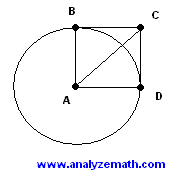
Squares and Circles: ABCD is a square with one vertex at the center of the circle and two vertices on the circle. What is the length of the diagonal \( AC \) if the area of the circle is 100 square cm?
View Step-by-Step Solution
Step 1: Find the radius squared
- Area = \( \pi r^2 = 100 \implies r^2 = \dfrac{100}{\pi} \).
Step 2: Use the Pythagorean theorem
- Because vertex A is at the center and B and D are on the circle, the sides \( AB \) and \( AD \) are equal to the circle's radius (\( r \)).
- In the right triangle \( \triangle ABC \), the diagonal \( AC \) is the hypotenuse.
- \( AC^2 = AB^2 + BC^2 = r^2 + r^2 = 2r^2 \)
- Substitute the value of \( r^2 \): \( AC^2 = 2\left(\dfrac{100}{\pi}\right) = \dfrac{200}{\pi} \).
- \( AC = \sqrt{\dfrac{200}{\pi}} = 10\sqrt{\dfrac{2}{\pi}} \approx \) \( 8 \text{ cm} \).
-
Perimeter vs Area Ratios: The ratio of the perimeter of circle A to the perimeter of circle B is 3:1. What is the ratio of the area of circle A to the area of circle B?
View Step-by-Step Solution
- Let \( R_A \) be the radius of circle A and \( R_B \) be the radius of circle B.
- The ratio of their perimeters (circumferences) is \( \dfrac{2\pi R_A}{2\pi R_B} = \dfrac{R_A}{R_B} = \dfrac{3}{1} \).
- Therefore, \( R_A = 3R_B \).
- The ratio of their areas is \( \dfrac{\pi R_A^2}{\pi R_B^2} \).
- Substitute \( 3R_B \) for \( R_A \): \( \dfrac{\pi(3R_B)^2}{\pi R_B^2} = \dfrac{9\pi R_B^2}{\pi R_B^2} = 9 \).
- The ratio of the areas is 9:1.
-
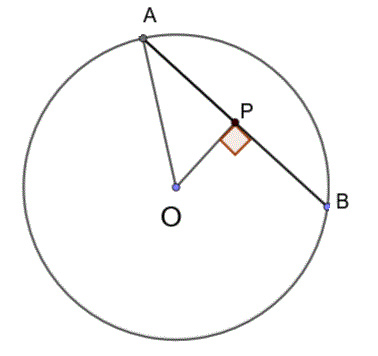
Intersecting Chords: In a circle with center \( O \), a chord \( AB \) is perpendicular to a radius. The radius intersects the chord at its midpoint, \( P \). If the length of the circle's radius is 10 units and the distance from the center to the chord (\( OP \)) is 6 units, find the length of the chord \( AB \).
View Step-by-Step Solution
- Because the radius is perpendicular to the chord, it creates a right-angled triangle \( \triangle OAP \), where \( O \) is the center, \( A \) is an endpoint of the chord, and \( P \) is the midpoint.
- The hypotenuse \( OA \) is the radius = 10 units.
- The leg \( OP \) is the distance to the chord = 6 units.
Step 1: Use the Pythagorean theorem to find \( AP \)
- \( OA^2 = OP^2 + AP^2 \)
- \( 10^2 = 6^2 + AP^2 \)
- \( 100 = 36 + AP^2 \)
- \( AP^2 = 100 - 36 = 64 \implies AP = 8 \text{ units} \).
Step 2: Find the total length of the chord
- Since \( P \) bisects the chord, \( AB = 2 \times AP \).
- \( AB = 2 \times 8 = \) \( 16 \text{ units} \).