A set of Calculus 1 questions with their detailed solutions to practice for tests, exams, placement exams, etc., and gain a deep understanding of the following core topics:
- Functions
- Limits
- Continuity
- Derivatives
- Applications of Derivatives
The questions were designed to cover the most important topics in Calculus 1, and each question includes an expandable detailed solution.
In what follows, \( C \) represents the constant of integration where applicable.
Practice Questions and Detailed Solutions
Click on each solution button to view the step-by-step breakdown.
-
Question 1
Find the domain of the function: \[ f(x) = \frac{\sqrt{x - 1}}{\sqrt{4 - x^2}} \]Show Solution to Question 1
For function \( f \) to take real values, the expression under the radical in the numerator must be non-negative, and the expression under the radical in the denominator must be positive. We solve the inequalities:
\[ x - 1 \ge 0 \quad \text{and} \quad 4 - x^2 > 0 \]The solution sets for the first and second inequalities are respectively:
\[ x \ge 1 \quad \text{and} \quad -2 < x < 2 \]Both conditions must be satisfied simultaneously. Therefore, the domain is the intersection of these two sets:
\[ 1 \le x < 2 \] -
Question 2
Find the range of the function: \[ f(x) = \frac{x - 1}{2 - 3x} \]Show Solution to Question 2
According to the properties of inverse functions, the range of \( f \) is the domain of its inverse.
First, prove that \( f \) is a one-to-one function by assuming \( f(a) = f(b) \) and showing \( a = b \):
\[ \frac{a - 1}{2 - 3a} = \frac{b - 1}{2 - 3b} \]Cross-multiplying and simplifying gives \( a = b \), proving invertibility. To find the inverse, start with:
\[ y = \frac{x - 1}{2 - 3x} \implies 2y - 3xy = x - 1 \implies x = \frac{2y + 1}{3y + 1} \]Interchanging \( x \) and \( y \) gives the inverse function:
\[ f^{-1}(x) = \frac{2x + 1}{3x + 1} \]The domain of \( f^{-1} \) excludes \( x = -\dfrac{1}{3} \). Thus, the range of \( f \) in interval notation is:
\[ \left(-\infty, -\frac{1}{3}\right) \cup \left(-\frac{1}{3}, +\infty\right) \] -
Question 3
Find the inverse of the function: \[ f(x) = \ln(2x - 3) + 2 \]Show Solution to Question 3
Write the function as an equation and solve for \( x \):
\[ y = \ln(2x - 3) + 2 \] \[ y - 2 = \ln(2x - 3) \] \[ e^{y - 2} = 2x - 3 \implies 2x = e^{y - 2} + 3 \implies x = \frac{1}{2}\left(e^{y - 2} + 3\right) \]Interchanging \( x \) and \( y \) gives the inverse function:
\[ f^{-1}(x) = \frac{1}{2}\left(e^{x - 2} + 3\right) \] -
Question 4
Evaluate each of the following limits:- \( \displaystyle \lim_{x \to 16} \frac{-\frac{1}{\sqrt{x}} + \frac{1}{4}}{x - 16} \)
- \( \displaystyle \lim_{x \to +\infty} \frac{-x^3 + 2x - 1}{x^4 - 3x^3 + 9} \)
- \( \displaystyle \lim_{x \to +\infty} x \sin\left(\frac{3}{x}\right) \)
- \( \displaystyle \lim_{x \to 0} \frac{\sin(x) + x}{2x^2 + x} \)
- \( \displaystyle \lim_{x \to +\infty} \frac{\sin(x) + 1}{x} \)
Show Solution to Question 4
a) The limit is of the indeterminate form \( \dfrac{0}{0} \). Multiply numerator and denominator by the conjugate of the numerator:
\[ \lim_{x \to 16} \frac{-\frac{1}{\sqrt{x}} + \frac{1}{4}}{x - 16} = \lim_{x \to 16} \frac{\left(-\frac{1}{\sqrt{x}} + \frac{1}{4}\right)\left(-\frac{1}{\sqrt{x}} - \frac{1}{4}\right)}{(x - 16)\left(-\frac{1}{\sqrt{x}} - \frac{1}{4}\right)} = \lim_{x \to 16} \frac{\frac{1}{x} - \frac{1}{16}}{(x - 16)\left(-\frac{1}{\sqrt{x}} - \frac{1}{4}\right)} \] \[ = \lim_{x \to 16} \frac{\frac{16 - x}{16x}}{(x - 16)\left(-\frac{1}{\sqrt{x}} - \frac{1}{4}\right)} = \lim_{x \to 16} \frac{-1}{16x\left(-\frac{1}{\sqrt{x}} - \frac{1}{4}\right)} = \frac{-1}{16(16)\left(-\frac{1}{4} - \frac{1}{4}\right)} = \frac{1}{128} \]b) The limit is of the form \( \dfrac{\infty}{\infty} \). Divide all terms by the highest power \( x^4 \):
\[ \lim_{x \to +\infty} \frac{-x^3 + 2x - 1}{x^4 - 3x^3 + 9} = \lim_{x \to +\infty} \frac{-\frac{1}{x} + \frac{2}{x^3} - \frac{1}{x^4}}{1 - \frac{3}{x} + \frac{9}{x^4}} = \frac{0}{1} = 0 \]c) Indeterminate form \( \infty \cdot 0 \). Let \( t = \dfrac{3}{x} \):
\[ \lim_{x \to +\infty} x \sin\left(\frac{3}{x}\right) = \lim_{t \to 0} 3 \frac{\sin(t)}{t} = 3 \times 1 = 3 \]d) Indeterminate form \( \dfrac{0}{0} \). Apply L'Hôpital's Rule:
\[ \lim_{x \to 0} \frac{\sin(x) + x}{2x^2 + x} = \lim_{x \to 0} \frac{\cos(x) + 1}{4x + 1} = \frac{\cos(0) + 1}{0 + 1} = 2 \]e) Since \( -1 \le \sin(x) \le 1 \), adding 1 gives \( 0 \le \sin(x) + 1 \le 2 \). Dividing by \( x > 0 \):
\[ 0 \le \frac{\sin(x) + 1}{x} \le \frac{2}{x} \]By the Squeeze Theorem, since limits of the bounds are 0, the limit evaluates to \( 0 \).
-
Question 5
a) Graph \( y = e^{x-1} \) and \( y = x \) in the same coordinate system, show that the two graphs are tangent at the point \( (1, 1) \), and verify that \( e^{x-1} \ge x \).
b) Use the result from part a) to determine the concavity of the function \( f(x) = \dfrac{x^3}{6} - e^{x-1} \) and any inflection points.Show Solution to Question 5
a) The derivative of \( y = e^{x-1} \) is \( y' = e^{x-1} \). At \( x = 1 \), slope \( m = e^{1-1} = 1 \). The tangent line at \( (1, 1) \) is \( y - 1 = 1(x - 1) \implies y = x \). Thus, the graphs are tangent at \( (1, 1) \) and \( e^{x-1} \ge x \).

Figure 2. Graphs of \( y = e^{x-1} \) and \( y = x \) b) Given \( f(x) = \dfrac{x^3}{6} - e^{x-1} \), the derivatives are:
\[ f'(x) = \frac{x^2}{2} - e^{x-1}, \quad f''(x) = x - e^{x-1} \]Since \( e^{x-1} \ge x \implies x - e^{x-1} \le 0 \), \( f''(x) \le 0 \) everywhere (with equality at \( x = 1 \)). Thus, \( f(x) \) is concave down on \( (-\infty, +\infty) \) and has no inflection points since \( f'' \) does not change sign.
-
Question 6
Find the derivative of the following functions (do not simplify the final answer):- \( f(x) = e^{x-1} + \ln(3x - 1) + \sin(2x + 1) \)
- \( g(x) = (2x - 1)^2(\tan(x) - 1) \)
- \( h(x) = \dfrac{x - \cos(x)}{x^2 - 2x + 1} \)
- \( m(x) = \sin\left(\sqrt{x^3 - \dfrac{1}{x} + 2}\right) \)
- \( n(x) = 3^{2x+3} + \log_3(2x - 1) \)
Show Solution to Question 6
a) Sum rule: \( f'(x) = e^{x-1} + \dfrac{3}{3x - 1} + 2\cos(2x + 1) \)
b) Product rule: \( g'(x) = 4(2x - 1)(\tan(x) - 1) + (2x - 1)^2\sec^2(x) \)
c) Quotient rule: \( h'(x) = \dfrac{(1 + \sin(x))(x^2 - 2x + 1) - (x - \cos(x))(2x - 2)}{(x^2 - 2x + 1)^2} \)
d) Chain rule: \( m'(x) = \cos\left(\sqrt{x^3 - \dfrac{1}{x} + 2}\right) \cdot \frac{1}{2}\left(3x^2 + \frac{1}{x^2}\right)\left(x^3 - \dfrac{1}{x} + 2\right)^{-1/2} \)
e) Rewriting bases: \( n(x) = e^{(2x+3)\ln 3} + \dfrac{\ln(2x-1)}{\ln 3} \implies n'(x) = (2\ln 3)3^{2x+3} + \dfrac{2}{\ln 3(2x - 1)} \)
-
Question 7
Find the equation of the tangent line to the curve given by \( \sin(y^2) = x^2 \) at the point \( (0, \sqrt{\pi}) \).Show Solution to Question 7
Differentiating implicitly with respect to \( x \):
\[ 2y \frac{dy}{dx}\cos(y^2) = 2x \implies \frac{dy}{dx} = \frac{x}{y\cos(y^2)} \]Evaluating at \( (0, \sqrt{\pi}) \):
\[ m = \frac{0}{\sqrt{\pi}\cos(\pi)} = 0 \]The equation of the horizontal tangent line is:
\[ y = \sqrt{\pi} \] -
Question 8
Find the constants \( a \) and \( b \) so that the function \( f \) is continuous on \( (-\infty, +\infty) \): \[ f(x) = \begin{cases} 2x - 1 & x \le 1 \\ ax^3 + b & 1 < x < 2 \\ x + 2b & x \ge 2 \end{cases} \]Show Solution to Question 8
Continuity at \( x = 1 \):
\[ \lim_{x \to 1^-} (2x - 1) = 1, \quad \lim_{x \to 1^+} (ax^3 + b) = a + b \implies a + b = 1 \quad \text{(Eq. 1)} \]Continuity at \( x = 2 \):
\[ \lim_{x \to 2^-} (ax^3 + b) = 8a + b, \quad \lim_{x \to 2^+} (x + 2b) = 2 + 2b \implies 8a + b = 2 + 2b \quad \text{(Eq. 2)} \]Solving equations (1) and (2) simultaneously yields:
\[ a = \frac{1}{3}, \quad b = \frac{2}{3} \] -
Question 9
Find the equation of the tangent line to the curve given by \( y = x + \sin(x) \) at \( x = 0 \).Show Solution to Question 9
Derivative: \( y' = 1 + \cos(x) \). Slope at \( x = 0 \) is \( m = 1 + \cos(0) = 2 \).
Point of tangency: \( P(0, 0 + \sin(0)) = (0, 0) \).
Tangent line equation: \( y - 0 = 2(x - 0) \implies y = 2x \).
-
Question 10
Use the definition of the derivative as a limit to find \( f'(x) \) where \( f(x) = \sqrt{x + 2} \).Show Solution to Question 10
Using the limit definition of the derivative:
\[ f'(x) = \lim_{h \to 0} \frac{\sqrt{x + h + 2} - \sqrt{x + 2}}{h} \]Multiply by the conjugate:
\[ f'(x) = \lim_{h \to 0} \frac{(x + h + 2) - (x + 2)}{h\left(\sqrt{x + h + 2} + \sqrt{x + 2}\right)} = \lim_{h \to 0} \frac{1}{\sqrt{x + h + 2} + \sqrt{x + 2}} = \frac{1}{2\sqrt{x + 2}} \] -
Question 11
Determine on what interval(s) the function \( f(x) = e^x(x^2 - 5x + 8) + \dfrac{x^4}{12} - \dfrac{x^3}{6} \) is concave up and concave down, and locate any inflection points.Show Solution to Question 11
First derivative: \( f'(x) = e^x(x^2 - 3x + 3) + \dfrac{x^3}{3} - \dfrac{x^2}{2} \)
Second derivative: \( f''(x) = e^x(x^2 - x) + x^2 - x = x(x - 1)e^x \)
Zeros of \( f'' \) are \( x = 0 \) and \( x = 1 \). Testing intervals:
- \( (-\infty, 0) \): \( f''(-1) > 0 \) (concave up)
- \( (0, 1) \): \( f''(1/2) < 0 \) (concave down)
- \( (1, +\infty) \): \( f''(2) > 0 \) (concave up)
Points of inflection occur at \( x = 0 \) and \( x = 1 \).
-
Question 12
Use Newton's method with an initial approximation \( x_1 = 2 \) to find a second approximation to the solution of the equation \( e^x = x^3 \).Show Solution to Question 12
Let \( f(x) = e^x - x^3 = 0 \). Then \( f'(x) = e^x - 3x^2 \).
Using Newton's algorithm \( x_{n+1} = x_n - \dfrac{f(x_n)}{f'(x_n)} \) with \( x_1 = 2 \):
\[ x_2 = 2 - \frac{e^2 - 2^3}{e^2 - 3(2^2)} \approx 1.87 \] -
Question 13
Find the absolute maximum and minimum of the function \( f(x) = x^4 - x^3 \) on the interval \( [0, 5] \).Show Solution to Question 13
Derivative: \( f'(x) = 4x^3 - 3x^2 = x^2(4x - 3) \). Critical points are \( x = 0 \) and \( x = 3/4 \).
Evaluating at endpoints and critical points on \( [0, 5] \):
\[ f(0) = 0, \quad f(5) = 500, \quad f(3/4) = -\frac{27}{256} \]Absolute maximum is \( 500 \) at \( x = 5 \), and absolute minimum is \( -\dfrac{27}{256} \) at \( x = 3/4 \).
-
Question 14
If the dimensions \( L \), \( W \), and \( H \) of a rectangular box are changing at the rates \( \dfrac{dL}{dt} = 0.1 \; \text{cm/sec} \), \( \dfrac{dW}{dt} = -0.2 \; \text{cm/sec} \), and \( \dfrac{dH}{dt} = 0.3 \; \text{cm/sec} \), at what rate is the volume of the box changing when \( L = 20 \; \text{cm} \), \( W = 8 \; \text{cm} \), and \( H = 5 \; \text{cm} \)?Show Solution to Question 14
Volume formula: \( V = LWH \). Differentiating with respect to time \( t \):
\[ \frac{dV}{dt} = WH\frac{dL}{dt} + LH\frac{dW}{dt} + LW\frac{dH}{dt} \]Substituting given values (\( L = 20, W = 8, H = 5, \dfrac{dL}{dt} = 0.1, \dfrac{dW}{dt} = -0.2, \dfrac{dH}{dt} = 0.3 \)):
\[ \frac{dV}{dt} = (8)(5)(0.1) + (20)(5)(-0.2) + (20)(8)(0.3) = 32 \; \text{cm}^3/\text{sec} \] -
Question 15
What are the dimensions of the rectangle with the largest area that can be inscribed in a semicircle of radius 3?
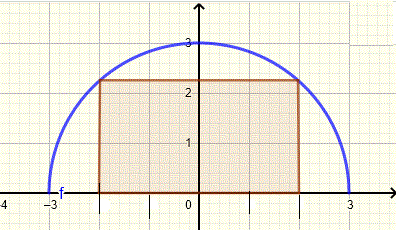
Figure 1. Inscribed rectangle in a semicircle Show Solution to Question 15
Circle equation: \( x^2 + y^2 = 9 \implies y = \sqrt{9 - x^2} \). Rectangle dimensions: \( L = 2x \) and \( W = \sqrt{9 - x^2} \).
Area function: \( A(x) = 2x\sqrt{9 - x^2} \) for \( 0 \le x \le 3 \).

Figure 3. Solution diagram for inscribed rectangle Derivative: \( A'(x) = \dfrac{2(-2x^2 + 9)}{\sqrt{9 - x^2}} \). Setting \( A'(x) = 0 \) gives critical point \( x = \sqrt{4.5} \).
Evaluating gives maximum area at \( x = \sqrt{4.5} \), leading to dimensions:
\[ L = 2\sqrt{4.5} \approx 4.24, \quad W = \sqrt{9 - 4.5} \approx 2.12 \]