Inverse Functions

First, we review the definition of inverse functions. Then we investigate the graphs of one-to-one functions and their inverses. More tutorials on finding inverse functions are included.

Page Content

1 - Definition and Properties of Inverse Functions

Definition

Let a function \(f\) be defined as a set of ordered pairs: \[ f = \{(-3, 0), (-1, 1), (0, 2), (1, 4), (5, 3)\} \] The inverse function \(g\) of \(f\) is obtained by interchanging the components of each ordered pair: \[ g = \{(0, -3), (1, -1), (2, 0), (4, 1), (3, 5)\} \]

Definition of the inverse of a function using Venn diagrams
Figure 1. Definition of the inverse of a function using Venn diagrams

The plots of \(f\) and \(g\) are shown below. Function \(f\) and its inverse \(g\) are reflections of each other on the line \(y = x\).

Definition of the inverse of a function
Figure 2. Graphical representation of a function and its inverse

2 - Inverse Function Notation

The inverse function of a one-to-one function \(f\) is denoted by \(f^{-1}\) and defined as: \[ f^{-1}(x) = \{(y, x) \mid y = f(x)\} \]

Note: The \(-1\) in \(f^{-1}\) is not an exponent. If \(f\) is not one-to-one, it does not have an inverse function.

3 - Domain and Range of a Function and its Inverse

Example: Let \[ f = \{(1,0),(4,5),(6,9)\} \] Then the inverse is \[ f^{-1} = \{(0,1),(5,4),(9,6)\} \] The domain of \(f\) is the range of \(f^{-1}\), and the range of \(f\) is the domain of \(f^{-1}\).

4 - Composition of a Function and its Inverse

In general: \[ f(f^{-1}(x)) = x, \quad x \in \text{domain of } f^{-1} \] \[ f^{-1}(f(x)) = x, \quad x \in \text{domain of } f \]

5 - Applications of Inverse Functions

In some situations, we know the output of a function and need to find the input. For example, solve for \(x\) such that \(0 < x < \pi/2\): \[ \sin(x) = 0.2 \implies x = \arcsin(0.2) \] Here \(\arcsin\) is the inverse of \(\sin\).

6 - Which Functions Have an Inverse?

Only one-to-one functions are invertible. For example: \[ f = \{(-3,0), (-1,2), (0,2), (1,4), (5,3)\} \] The inverse would be \[ g = \{(0,-3),(2,-1),(2,0),(4,1),(3,5)\} \] But \(g\) is not a function because input \(2\) has two outputs (\(-1\) and \(0\)). Therefore, \(f\) is not invertible.

Inverse is not a function using Venn diagram
Figure 4. Inverse of a non-invertible function
Inverse is not a function
Figure 5. Graphical example showing non-invertible function

7 - Important Properties of Functions and Their Inverses

8 - Graphical Investigation

Graphs of functions (blue) and their inverses (red):

For each function graphed below:

  1. Select points on \(f\) and determine corresponding points on \(f^{-1}\)
  2. Explain why the graphs of a function and its inverse are reflections across \(y = x\)
  3. Determine domain and range of each function and its inverse

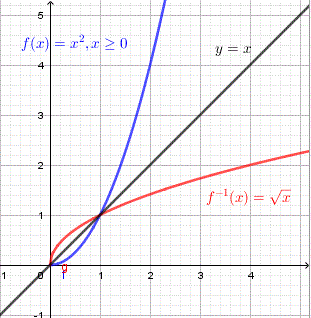
a) Quadratic function with restricted domain:

Inverse of quadratic function with restricted domain.

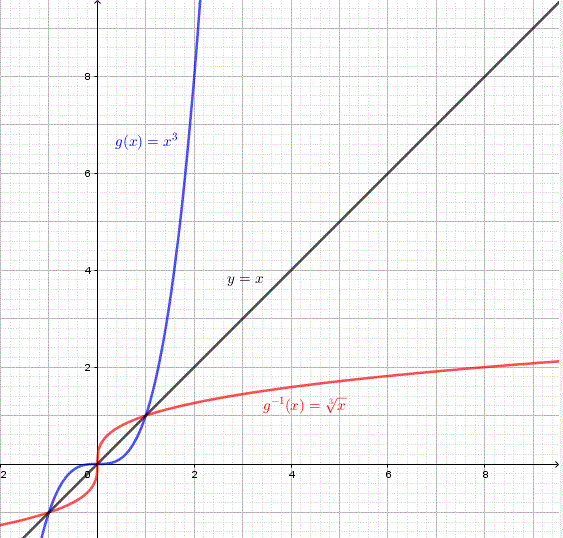
b) Cubic function:

Inverse of cubic function.

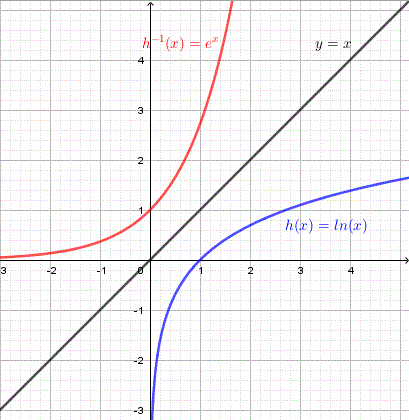
c) Logarithmic function:

Inverse of logarithmic function.
View Graphical Analysis Answers

a) \(f(x) = x^2, x \ge 0\)
Points on \(f\): \((0,0), (1,1), (2,4)\)
Points on \(f^{-1}\): \((0,0), (1,1), (4,2)\)

b) \(g(x) = x^3\)
Points on \(g\): \((-1,-1), (0,0), (1,1), (2,8)\)
Points on \(g^{-1}\): \((-1,-1), (0,0), (1,1), (8,2)\)

c) \(h(x) = \ln(x)\)
Points on \(h\): \((1,0), (4,1.4)\)
Points on \(h^{-1}\): \((0,1), (1.4,4)\)

9 - Exercises with Solutions

Exercise 1: Find the domain and range of \[ f = \{(-4,2),(-3,1),(0,5),(2,6)\} \] Find its inverse and its domain and range.

Exercise 2: Identify functions without inverses: \[ f = \{(-1,2),(-3,1),(0,2),(5,6)\},\quad g = \{(-3,0),(-1,1),(0,5),(2,6)\},\quad h = \{(2,2),(3,1),(6,5),(7,1)\} \]

View Exercise Answers & Solutions

Exercise 1 Solution:
Domain of \(f = \{-4,-3,0,2\}\), Range of \(f = \{2,1,5,6\}\)
Inverse: \(f^{-1} = \{(2,-4),(1,-3),(5,0),(6,2)\}\)
Domain of \(f^{-1} = \{2,1,5,6\}\), Range of \(f^{-1} = \{-4,-3,0,2\}\)

Exercise 2 Solution:
Functions \(f\) and \(h\) are not one-to-one (they map multiple inputs to the same output); therefore, they do not have inverse functions. Function \(g\) is one-to-one and invertible.

More References