Des problèmes liés au théorème des accroissements finis, avec des solutions détaillées, sont présentés.
Dans ce qui suit, \( C \) représente la constante d'intégration le cas échéant.
Théorème des accroissements finis : Rappel
Si \( f \) est une fonction continue sur l'intervalle \( [a, b] \) et dérivable sur \( (a, b) \), alors il existe au moins un nombre réel \( c \) dans l'intervalle \( (a, b) \) tel que :
\[ f'(c) = \dfrac{f(b) - f(a)}{b - a} \]Le théorème des accroissements finis exprime la relation entre la pente de la tangente à la courbe en \( x = c \) et la pente de la sécante à la courbe passant par les points \( (a, f(a)) \) et \( (b, f(b)) \).
Problèmes avec solutions détaillées
Cliquez sur chaque problème pour afficher sa solution détaillée étape par étape.
Problème 1
Trouvez une valeur de \( c \) telle que la conclusion du théorème des accroissements finis soit satisfaite pour :
\[ f(x) = -2x^3 + 6x - 2 \]sur l'intervalle \( [-2, 2] \).
Afficher la solution du problème 1
\( f(x) \) est une fonction polynomiale, elle est donc continue et dérivable pour tous les nombres réels. Évaluons \( f(x) \) en \( x = -2 \) et \( x = 2 \) :
\[ f(-2) = -2(-2)^3 + 6(-2) - 2 = 2 \] \[ f(2) = -2(2)^3 + 6(2) - 2 = -6 \]Évaluons \( \dfrac{f(b) - f(a)}{b - a} \) :
\[ \dfrac{f(b) - f(a)}{b - a} = \dfrac{-6 - 2}{2 - (-2)} = \dfrac{-8}{4} = -2 \]Trouvons maintenant \( f'(x) \) :
\[ f'(x) = -6x^2 + 6 \]Construisons maintenant une équation basée sur \( f'(c) = \dfrac{f(b) - f(a)}{b - a} \) :
\[ -6c^2 + 6 = -2 \]Résolvons pour \( c \) afin d'obtenir 2 solutions :
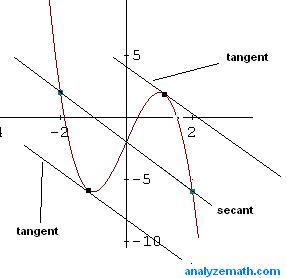
\[ -6c^2 = -8 \implies c^2 = \dfrac{8}{6} = \dfrac{4}{3} \] \[ c = \pm \sqrt{\dfrac{4}{3}} = \pm \dfrac{2}{\sqrt{3}} = \pm \dfrac{2\sqrt{3}}{3} \]Ci-dessous est présenté le graphique de \( f \), d'une sécante et des deux tangentes correspondant aux deux solutions trouvées. La sécante et les deux tangentes sont parallèles puisque leurs pentes sont égales d'après le théorème des accroissements finis.
Problème 2
Utilisez le théorème des accroissements finis pour prouver que pour tous nombres réels \( a \) et \( b \) :
\[ |\cos a - \cos b| \le |a - b| \]Afficher la solution du problème 2
La fonction \( f(x) = \cos x \) est continue et dérivable pour tous les nombres réels. En appliquant le théorème des accroissements finis sur l'intervalle entre \( a \) et \( b \) (en supposant \( a \neq b \)) :
\[ \dfrac{\cos a - \cos b}{a - b} = f'(c) \]où \( c \) est compris entre \( a \) et \( b \). Puisque \( f'(x) = -\sin x \), nous avons :
\[ \dfrac{\cos a - \cos b}{a - b} = -\sin c \]Prenons la valeur absolue des deux côtés :
\[ \left| \dfrac{\cos a - \cos b}{a - b} \right| = |-\sin c| = |\sin c| \]Puisque \( |\sin c| \le 1 \) pour tout nombre réel \( c \), nous avons :
\[ \left| \dfrac{\cos a - \cos b}{a - b} \right| \le 1 \]D'après les propriétés de la valeur absolue, \( \left| \dfrac{x}{y} \right| = \dfrac{|x|}{|y|} \) :
\[ \dfrac{|\cos a - \cos b|}{|a - b|} \le 1 \]Multiplions les deux côtés par \( |a - b| \) pour obtenir :
\[ |\cos a - \cos b| \le |a - b| \]Remarque : Si \( a = b \), l'inégalité est trivialement vérifiée car \( 0 \le 0 \).