Maximisez l'aire d'un rectangle inscrit dans un triangle rectangle en utilisant la première dérivée. Le problème et sa solution détaillée sont présentés ci-dessous.
Dans ce qui suit, \( C \) représente la constante d'intégration le cas échéant.
Problème et solution
BDEF est un rectangle inscrit dans le triangle rectangle ABC dont les longueurs des côtés sont 40 et 30. Trouvez les dimensions du rectangle BDEF de sorte que son aire soit maximale.

Afficher la solution du problème
Soit la longueur BF du rectangle égale à \( y \) et sa largeur BD égale à \( x \). L'aire du triangle rectangle est donnée par :
\[ \frac{1}{2} \times 40 \times 30 = 600 \]L'aire du triangle rectangle peut également être calculée comme la somme des aires du triangle BEC et du triangle BEA (découpés par le rectangle). Par conséquent :
\[ 600 = \frac{1}{2} \times 40 \times y + \frac{1}{2} \times 30 \times x \]Soit \( A \) l'aire du rectangle. Ainsi :
\[ A = y \times x \]Nous utilisons maintenant la première équation pour exprimer \( y \) en fonction de \( x \) :
\[ y = \frac{600 - 15x}{20} \]Substituons \( y \) dans \( A \) pour obtenir l'aire en fonction de \( x \) :
\[ A(x) = \frac{x(600 - 15x)}{20} \]Un développement de \( A(x) \) montre que \( A(x) \) est une fonction quadratique avec un coefficient dominant négatif, et possède donc une valeur maximale :
\[ A(x) = -\frac{3}{4}x^2 + 30x \]Le graphique de \( A(x) \) en fonction de \( x \) est présenté ci-dessous. \( A(x) \) atteint une valeur maximale pour \( x = 20 \), comme vérifié analytiquement ci-dessous :

Nous calculons maintenant la première dérivée de \( A(x) \) :
\[ A'(x) = -\frac{3}{2}x + 30 \]Posons \( A'(x) = 0 \) et résolvons pour \( x \) :
\[ -\frac{3}{2}x + 30 = 0 \implies x = 20 \]Il est facile de vérifier que \( A'(x) \) est positif pour \( x < 20 \) et négatif pour \( x > 20 \), ce qui confirme que \( A(x) \) a un maximum en \( x = 20 \).
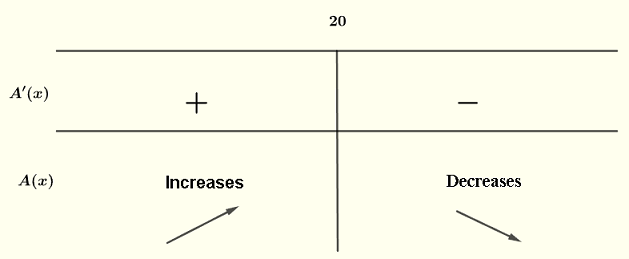
L'aire maximale est donnée par \( A(20) \) :
\[ A(20) = -\frac{3}{4} \times 20^2 + 30 \times 20 = 300 \]Nous trouvons maintenant \( y \) en utilisant la formule de l'aire :
\[ A = 300 = x \times y \implies y = \frac{300}{20} = 15 \]Conclusion : Les dimensions du rectangle qui maximisent son aire sont \( x = 20 \) et \( y = 15 \).