Maximisez l'aire d'un rectangle inscrit dans un triangle en utilisant la première dérivée. Ce problème d'optimisation et sa solution détaillée sont présentés ci-dessous.
Dans ce qui suit, \( C \) représente la constante d'intégration le cas échéant.
Problème
OAB est un triangle avec des sommets donnés. Trouvez les dimensions du rectangle d'aire maximale inscrit dans le triangle de telle sorte que l'un de ses côtés repose sur le côté OA du triangle.

Afficher la solution du problème
Dans la figure ci-dessous, un rectangle de largeur \( W \) et de longueur \( L \) est inscrit à l'intérieur du triangle, ses sommets supérieurs reposant sur les côtés du triangle. Nous trouvons d'abord une formule pour l'aire du rectangle en fonction de \( x \) uniquement.
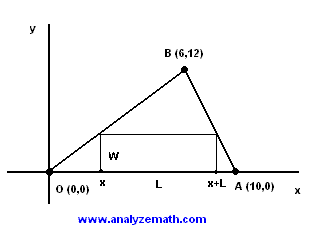
La pente \( m_1 \) de la droite passant par OB est donnée par :
\[ m_1 = \frac{12 - 0}{6 - 0} = 2 \]Soit \( (x, y) \) les coordonnées du sommet supérieur gauche du rectangle. Par conséquent :
\[ m_1 = 2 = \frac{y - 0}{x - 0} = \frac{y}{x} \]Par conséquent, la largeur \( W \) du rectangle est donnée par :
\[ W = y = 2x \]La pente \( m_2 \) de la droite passant par AB (de \( (6, 12) \) à \( (10, 0) \)) est donnée par :
\[ m_2 = \frac{0 - 12}{10 - 6} = \frac{-12}{4} = -3 \]Si le sommet supérieur droit du rectangle a pour coordonnées \( (x + L, y) \), il appartient à la droite AB passant par \( (10, 0) \) :
\[ m_2 = -3 = \frac{y - 0}{(x + L) - 10} \]En résolvant pour \( y \) :
\[ y = -3(x + L - 10) = -3(x + L) + 30 \]Puisque \( y = W = 2x \), nous égalons les deux expressions de \( y \) :
\[ 2x = -3(x + L) + 30 \]En résolvant pour \( L \) :
\[ 2x = -3x - 3L + 30 \implies 3L = 30 - 5x \implies L = 10 - \frac{5}{3}x \]L'aire \( A \) du rectangle est donnée par :
\[ A = W \cdot L = 2x \left(10 - \frac{5}{3}x\right) = -\frac{10}{3}x^2 + 20x \]\( A \) est une fonction quadratique de \( x \) de la forme \( ax^2 + bx + c \). Puisque son coefficient dominant \( a = -\dfrac{10}{3} \) est négatif, elle atteint une valeur maximale au point critique de sa première dérivée \( A'(x) \).
Calcul de la première dérivée :
\[ A'(x) = -\frac{20}{3}x + 20 \]En posant \( A'(x) = 0 \) pour trouver les points critiques :
\[ -\frac{20}{3}x + 20 = 0 \implies x = 3 \]Ainsi, l'aire \( A \) du rectangle possède une valeur maximale en \( x = 3 \), avec les dimensions :
- \( W = 2x = 2(3) = 6 \)
- \( L = 10 - \frac{5}{3}(3) = 10 - 5 = 5 \)
L'aire maximale est \( A = 6 \times 5 = 30 \).