La première dérivée est utilisée pour maximiser l'aire d'un triangle inscrit dans un cercle. Un problème d'optimisation avec une solution détaillée est présenté ci-dessous.
Dans ce qui suit, \( C \) représente la constante d'intégration le cas échéant.
Problème
Sur l'image ci-dessous, le triangle ABC est inscrit dans un cercle de centre O et de rayon \( r \). Pour un rayon constant \( r \) du cercle, le point B glisse le long du cercle de sorte que l'aire de ABC change. Trouvez les longueurs des côtés AB et CB pour que l'aire du triangle ABC soit maximale.
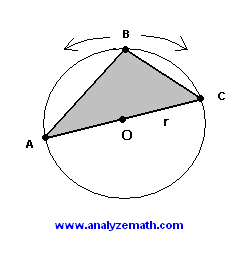
Afficher la solution du problème
Puisque le centre O du cercle se trouve sur le côté AC du triangle, AC est un diamètre du cercle et le triangle ABC est un triangle rectangle (théorème de Thalès). Son angle droit est en B et son hypoténuse AC a une longueur égale à \( 2r \) (voir la figure ci-dessous).

L'aire \( S \) du triangle est donnée par :
\[ S = \frac{1}{2} AB \times CB \]En utilisant l'angle \( t \), \( AB \) et \( CB \) peuvent être exprimés comme suit :
\[ AB = AC \cos t \quad \text{et} \quad CB = AC \sin t \]Substituons \( AB \) et \( CB \) dans la formule de l'aire :
\[ S = \frac{1}{2} AC^2 \cos t \sin t \]En utilisant l'identité trigonométrique \( \sin(2t) = 2 \sin t \cos t \), nous exprimons l'aire \( S \) sous la forme :
\[ S = \frac{1}{4} AC^2 \sin(2t) \]Puisque le rayon \( r \) est constant, la longueur du diamètre \( AC = 2r \) l'est également. Par conséquent, l'aire dépend uniquement de l'angle \( t \) lorsque le point B glisse le long du cercle. Pour trouver \( t \) de sorte que \( S \) soit maximale, nous calculons la première dérivée par rapport à \( t \) :
\[ \frac{dS}{dt} = \frac{1}{4} AC^2 \cdot 2 \cos(2t) = \frac{1}{2} AC^2 \cos(2t) \]En posant \( \frac{dS}{dt} = 0 \) pour trouver les points stationnaires :
\[ \frac{1}{2} AC^2 \cos(2t) = 0 \implies \cos(2t) = 0 \]Au fur et à mesure que le point B glisse le long du cercle, l'angle \( t \) varie de \( 0 \) à \( 90^\circ \). La solution de \( \cos(2t) = 0 \) dans l'intervalle \( (0^\circ, 90^\circ) \) est :
\[ 2t = 90^\circ \implies t = 45^\circ \]Lorsque \( t \) passe de \( 0^\circ \) à \( 45^\circ \), \( 2t \) passe de \( 0^\circ \) à \( 90^\circ \) et \( \frac{dS}{dt} \) est positive. Lorsque \( t \) passe de \( 45^\circ \) à \( 90^\circ \), \( 2t \) passe de \( 90^\circ \) à \( 180^\circ \) et \( \frac{dS}{dt} \) est négative. Par conséquent, \( t = 45^\circ \) donne la valeur maximale de l'aire \( S \).
Lorsque \( t = 45^\circ \), les longueurs des côtés \( AB \) et \( CB \) sont :
\[ AB = AC \cos(45^\circ) = 2r \left(\frac{\sqrt{2}}{2}\right) = r\sqrt{2} \] \[ CB = AC \sin(45^\circ) = 2r \left(\frac{\sqrt{2}}{2}\right) = r\sqrt{2} \]Conclusion : L'aire est maximale lorsque \( t = 45^\circ \), ce qui signifie que le triangle rectangle inscrit est un triangle rectangle isocèle avec des longueurs de côtés \( AB = CB = r\sqrt{2} \).