La première dérivée est utilisée pour maximiser (optimiser) la puissance délivrée à une charge dans les circuits électroniques.
Dans ce qui suit, \( C \) représente la constante d'intégration le cas échéant.
Problème
Dans le circuit électronique représenté ci-dessous, la tension \( E \) (en Volts) et la résistance \( r \) (en Ohms) sont constantes. \( R \) est la résistance d'une charge. Dans un tel circuit, le courant électrique \( i \) est donné par :
\[ i = \dfrac{E}{r + R} \]et la puissance \( P \) délivrée à la charge \( R \) est donnée par :
\[ P = R i^2 \]Sachant que \( r \) et \( R \) sont positifs, déterminez \( R \) de telle sorte que la puissance \( P \) délivrée à \( R \) soit maximale.
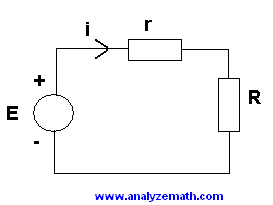
Afficher la solution du problème
Nous exprimons d'abord la puissance \( P \) en fonction de \( E \), \( r \) et de la variable \( R \) en substituant \( i = \dfrac{E}{r + R} \) dans \( P = R i^2 \) :
\[ P(R) = \frac{R E^2}{(r + R)^2} \]Nous dérivons maintenant \( P \) par rapport à la variable \( R \) en utilisant la règle du quotient :
\[ \frac{dP}{dR} = \frac{E^2 \left[(r + R)^2 - R \cdot 2(r + R)\right]}{(r + R)^4} = \frac{E^2 \left[(r + R) - 2R\right]}{(r + R)^3} = \frac{E^2 (r - R)}{(r + R)^3} \]Pour déterminer si \( P \) possède un maximum local, nous trouvons les points critiques en posant \( \dfrac{dP}{dR} = 0 \) et en résolvant pour \( R \) :
\[ \frac{E^2 (r - R)}{(r + R)^3} = 0 \implies R = r \]Puisque \( r \) et \( R \) sont tous deux positifs (résistances), \( \dfrac{dP}{dR} \) n'a qu'un seul point critique en \( R = r \). De plus, pour \( R < r \), \( \dfrac{dP}{dR} \) est positif et \( P \) croît ; pour \( R > r \), \( \dfrac{dP}{dR} \) est négatif et \( P \) décroît. Par conséquent, \( P \) atteint une valeur maximale absolue en \( R = r \).
La puissance maximale se calcule en substituant \( R = r \) dans \( P(R) \) :
\[ P(r) = \frac{r E^2}{(r + r)^2} = \frac{r E^2}{(2r)^2} = \frac{r E^2}{4r^2} = \frac{E^2}{4r} \]Par conséquent, pour réaliser un transfert de puissance maximale du circuit électronique vers la charge \( R \), la résistance de charge \( R \) doit être égale à la résistance interne \( r \).
À titre d'exemple, le tracé de \( P(R) \) pour \( E = 5 \) volts et \( r = 100 \) Ohms est présenté ci-dessous. Il illustre clairement que \( P \) est maximisée lorsque \( R = 100 \) Ohms (\( R = r \)).

Examinons plus en détail \( P(R) \) : si \( R \) tend vers zéro, \( P(R) \) tend vers zéro. Si \( R \) augmente indéfiniment, \( P(R) \) tend vers zéro puisque l'axe horizontal est une asymptote horizontale du graphique de \( P(R) \). Ainsi, \( P(R) \) atteint un maximum pour une valeur finie de \( R = r \).