La première dérivée est utilisée pour minimiser l'aire de la surface d'une pyramide à base carrée.
Dans ce qui suit, \( C \) représente la constante d'intégration le cas échéant.
Problème
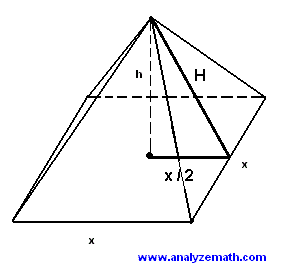
Ci-dessous est représentée une pyramide à base carrée de longueur de côté \( x \) et de hauteur \( h \). Trouvez la valeur de \( x \) de sorte que le volume de la pyramide soit de \( 1000 \; \text{cm}^3 \) et que son aire de surface soit minimale.
Afficher la solution du problème
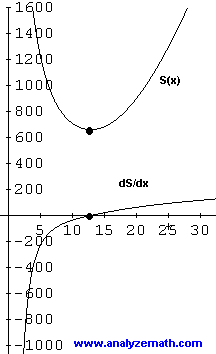
Ce problème a été résolu graphiquement. Nous le résolvons ici de manière plus rigoureuse en utilisant la première dérivée.
Nous utilisons d'abord la formule du volume d'une pyramide pour écrire l'équation :
\[ \frac{1}{3} h x^2 = 1000 \]La pyramide est composée de 4 faces triangulaires et d'une base carrée. L'aire d'une face triangulaire est donnée par :
\[ s = \frac{1}{2} H x \]L'apothème (hauteur inclinée) \( H \) est donnée par le théorème de Pythagore :
\[ H = \sqrt{h^2 + \left(\frac{x}{2}\right)^2} \]L'aire totale de la surface \( S \) de la pyramide est la somme des aires des 4 triangles et de l'aire de la base \( x^2 \) :
\[ S = 4\left(\frac{1}{2} H x\right) + x^2 = 2x \sqrt{h^2 + \left(\frac{x}{2}\right)^2} + x^2 \]Résolvons l'équation du volume \( \dfrac{1}{3} h x^2 = 1000 \) pour \( h \) :
\[ h = \frac{3000}{x^2} \]Substituons \( h \) dans la formule de l'aire de la surface pour exprimer \( S \) en fonction de \( x \) seul :
\[ S(x) = 2x \sqrt{\left(\frac{3000}{x^2}\right)^2 + \frac{x^2}{4}} + x^2 = 2x \sqrt{\frac{9 \times 10^6}{x^4} + \frac{x^2}{4}} + x^2 \] \[ S(x) = 2x \sqrt{\frac{36 \times 10^6 + x^6}{4x^4}} + x^2 = 2x \cdot \frac{\sqrt{36 \times 10^6 + x^6}}{2x^2} + x^2 \] \[ S(x) = \frac{\sqrt{36 \times 10^6 + x^6}}{x} + x^2 \]Soit la constante \( k = 36 \times 10^6 \) et dérivons \( S \) par rapport à \( x \) :
\[ \frac{dS}{dx} = \frac{x \cdot \frac{1}{2}(k + x^6)^{-1/2}(6x^5) - \sqrt{k + x^6}}{x^2} + 2x \] \[ \frac{dS}{dx} = \frac{\frac{3x^6}{\sqrt{k + x^6}} - \sqrt{k + x^6}}{x^2} + 2x = \frac{3x^6 - (k + x^6)}{x^2 \sqrt{k + x^6}} + 2x = \frac{2x^6 - k}{x^2 \sqrt{k + x^6}} + 2x \]
Pour \( x > 0 \), \( \dfrac{dS}{dx} \) possède un unique zéro, étant négative à gauche et positive à droite. Cela confirme que \( S \) possède une valeur minimale localisée en posant \( \dfrac{dS}{dx} = 0 \) :
\[ \frac{2x^6 - k}{x^2 \sqrt{k + x^6}} + 2x = 0 \implies \frac{2x^6 - k}{x^2} = -2x \sqrt{k + x^6} \]Posons \( u = x^3 \) (donc \( u^2 = x^6 \)) et substituons :
\[ \frac{2u^2 - k}{u^{2/3}} \quad \text{ou simplifions directement :} \] \[ 2x^6 - k = -2x^3 \sqrt{k + x^6} \implies 2u^2 - k = -2u \sqrt{k + u^2} \]Élevons les deux côtés au carré :
\[ (2u^2 - k)^2 = 4u^2(k + u^2) \implies 4u^4 + k^2 - 4ku^2 = 4ku^2 + 4u^4 \] \[ k^2 - 4ku^2 = 4ku^2 \implies k^2 = 8ku^2 \implies u^2 = \frac{k}{8} \]Puisque \( u > 0 \) :
\[ u = \sqrt{\frac{k}{8}} \implies x^3 = \sqrt{\frac{k}{8}} \implies x = \left(\frac{k}{8}\right)^{1/6} \]Substituons \( k = 36 \times 10^6 \) :
\[ x = \left(\frac{36 \times 10^6}{8}\right)^{1/6} = (4\,500\,000)^{1/6} \approx 16,19 \; \text{cm} \](Remarque : Arrondi à 1 décimale à \( 16,2 \; \text{cm} \).)