La première dérivée est utilisée pour minimiser (optimiser) la distance parcourue entre deux points.
Dans ce qui suit, \( C \) représente la constante d'intégration le cas échéant.
Problème
Le schéma ci-dessous montre le chemin que Wilson emprunte chaque matin pour prendre de l'eau de la rivière jusqu'à sa ferme. Aidez Wilson à minimiser la distance totale parcourue de sa maison à la ferme.
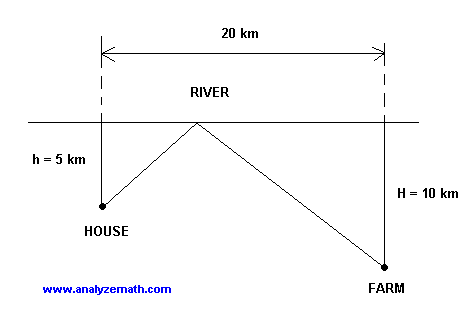
Afficher la solution du problème
Deux méthodes pour résoudre ce problème sont suggérées ci-dessous.
MÉTHODE 1 : Analyse (Première dérivée)
Dans le schéma ci-dessous, nous trouvons les distances \( d \) et \( D \), les additionnons et minimisons la distance totale.

La distance totale \( T \) est donnée par :
\[ T = d + D = \sqrt{x^2 + 25} + \sqrt{(20 - x)^2 + 100} \]Nous trouvons maintenant la première dérivée \( \dfrac{dT}{dx} \) de \( T \) par rapport à \( x \), vérifions que \( T \) possède une valeur minimale et trouvons la valeur de \( x \) qui minimise \( T \) :
\[ \frac{dT}{dx} = \frac{x}{\sqrt{x^2 + 25}} - \frac{20 - x}{\sqrt{(20 - x)^2 + 100}} \]Le graphique de \( \dfrac{dT}{dx} \) est présenté ci-dessous. À environ \( x = 6,67 \), la première dérivée est égale à zéro ; en dessous de cette valeur, elle est négative, et au-dessus, elle est positive. Par conséquent, \( T \) possède une valeur minimale autour de \( x = 6,67 \).

En posant \( \dfrac{dT}{dx} = 0 \) pour trouver la valeur critique :
\[ \frac{x}{\sqrt{x^2 + 25}} = \frac{20 - x}{\sqrt{(20 - x)^2 + 100}} \]En effectuant le produit en croix :
\[ x \sqrt{(20 - x)^2 + 100} = (20 - x) \sqrt{x^2 + 25} \]En élevant les deux côtés au carré :
\[ x^2 \left((20 - x)^2 + 100\right) = (20 - x)^2 (x^2 + 25) \] \[ x^2(400 - 40x + x^2 + 100) = (400 - 40x + x^2)(x^2 + 25) \] \[ x^2(x^2 - 40x + 500) = (x^2 - 40x + 400)(x^2 + 25) \] \[ x^4 - 40x^3 + 500x^2 = x^4 + 25x^2 - 40x^3 - 1000x + 400x^2 + 10000 \] \[ 500x^2 = 425x^2 - 1000x + 10000 \implies 75x^2 + 1000x - 10000 = 0 \]Division de l'équation quadratique par 25 :
\[ 3x^2 + 40x - 400 = 0 \]En résolvant pour \( x \) à l'aide de la formule quadratique et en sélectionnant la valeur positive :
\[ x = \frac{-40 + \sqrt{40^2 - 4(3)(-400)}}{2(3)} = \frac{-40 + \sqrt{1600 + 4800}}{6} = \frac{-40 + \sqrt{6400}}{6} = \frac{-40 + 80}{6} = \frac{40}{6} = \frac{20}{3} \approx 6,67 \; \text{km} \]MÉTHODE 2 : Projection géométrique
Nous construisons une « maison virtuelle » (réflexion) \( H \) de l'autre côté de la rivière. Pour que la distance totale \( d + D \) soit minimale, les points \( H \), \( O \) et \( F \) doivent être colinéaires car la plus courte distance entre deux points est une ligne droite. Pour que ces points soient colinéaires, les angles \( HOH' \) et \( FOF' \) doivent être de même mesure, ce qui signifie que leurs tangentes sont égales.

Calcul des tangentes pour les deux angles en fonction de \( x \) :
\[ \tan(HOH') = \frac{5}{x} \] \[ \tan(FOF') = \frac{10}{20 - x} \]En égalant les tangentes :
\[ \frac{5}{x} = \frac{10}{20 - x} \]En résolvant pour \( x \) :
\[ 5(20 - x) = 10x \implies 100 - 5x = 10x \implies 15x = 100 \implies x = \frac{100}{15} = \frac{20}{3} \approx 6,67 \; \text{km} \]