Un problème visant à minimiser (optimiser) le temps nécessaire pour marcher d'un point à un autre est présenté. Une méthode analytique, utilisant des dérivées ainsi que d'autres concepts et théorèmes d'analyse, est développée afin de trouver une solution analytique au problème.
Dans ce qui suit, \( C \) représente la constante d'intégration le cas échéant.
Problème
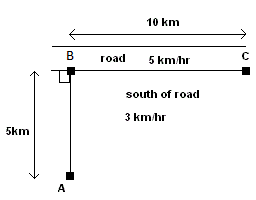
Vous décidez de marcher du point A (voir la figure ci-dessous) au point C. Au sud de la route passant par BC, le terrain est difficile et vous ne pouvez marcher qu'à \( 3 \; \text{km/h} \). Cependant, le long de la route BC, vous pouvez marcher à \( 5 \; \text{km/h} \). La distance du point A à la route est de \( 5 \; \text{km} \). La distance de B à C est de \( 10 \; \text{km} \). Quel chemin devez-vous emprunter pour arriver au point C dans le temps le plus court (minimal) possible ?
Afficher la solution du problème
Supposons que vous suiviez le chemin de A à P et de P à C le long de lignes droites. Soit la distance BP égale à \( x \). En utilisant le théorème de Pythagore, nous pouvons exprimer les distances AP et PC :
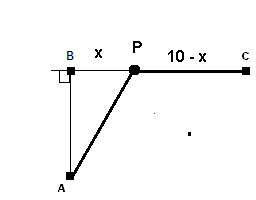
Nous trouvons maintenant le temps \( t_1 \) pour parcourir la distance AP (\( \text{temps} = \text{distance} / \text{vitesse} \)) :
\[ t_1 = \frac{\sqrt{5^2 + x^2}}{3} \]Le temps \( t_2 \) pour parcourir la distance PC est donné par :
\[ t_2 = \frac{10 - x}{5} \]Le temps total \( t \) est obtenu en additionnant \( t_1 \) et \( t_2 \) :
\[ t(x) = \frac{\sqrt{5^2 + x^2}}{3} + \frac{10 - x}{5} \]Le domaine de la fonction \( t(x) \) est l'intervalle fermé \( [0, 10] \). Pour des valeurs de \( x \) en dehors de cet intervalle (où le point P est à gauche de B ou à droite de C), le temps total augmentera.
Pour trouver la valeur de \( x \) qui minimise \( t \), nous calculons la première dérivée \( \dfrac{dt}{dx} \) :
\[ \frac{dt}{dx} = \frac{\frac{x}{3}}{\sqrt{5^2 + x^2}} - \frac{1}{5} \]En posant \( \dfrac{dt}{dx} = 0 \) pour trouver les points critiques :
\[ \frac{x}{3\sqrt{25 + x^2}} - \frac{1}{5} = 0 \implies \frac{x}{3\sqrt{25 + x^2}} = \frac{1}{5} \]En effectuant le produit en croix :
\[ 5x = 3\sqrt{25 + x^2} \]En élevant les deux côtés au carré :
\[ (5x)^2 = 9(25 + x^2) \implies 25x^2 = 225 + 9x^2 \]En regroupant les termes semblables :
\[ 16x^2 = 225 \implies x^2 = \frac{225}{16} \]En résolvant pour \( x \) (\( x > 0 \)) :
\[ x = \sqrt{\frac{225}{16}} = \frac{15}{4} = 3,75 \; \text{km} \]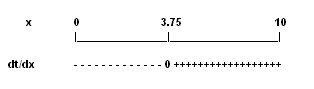
La première dérivée \( \dfrac{dt}{dx} \) est négative pour \( x < 3,75 \), nulle en \( x = 3,75 \) et positive pour \( x > 3,75 \). L'évaluation de \( t(x) \) aux bornes donne \( t(0) \approx 3,6 \; \text{h} \) et \( t(10) \approx 3,7 \; \text{h} \), tandis qu'en \( x = 3,75 \), \( t(3,75) \approx 3,3 \; \text{h} \) (le minimum).
Conclusion : Vous devez marcher vers le point P de sorte que \( BP = 3,75 \; \text{km} \), puis continuer le long de la route jusqu'à C pour arriver dans le temps le plus court possible.
Exercices
-
Exercice 1 : Résolvez le même problème que ci-dessus mais avec les paramètres modifiés indiqués dans le schéma ci-dessous.

Figure 4. Schéma pour l'exercice d'entraînement Afficher la solution de l'exercice 1
En suivant la même méthode analytique par dérivation avec les paramètres de l'exercice :
\[ x = 6,26 \; \text{km} \quad (\text{arrondi à 2 décimales}) \]