Un point critique d'une fonction à plusieurs variables est un point où les dérivées partielles du premier ordre de cette fonction sont égales à zéro. Des exemples avec des solutions détaillées sur la façon de trouver les points critiques d'une fonction à deux variables sont présentés.
Explorez d'autres problèmes d'optimisation avec des fonctions de deux variables sur ce site Web.
Dans ce qui suit, \( C \) représente la constante d'intégration le cas échéant.
Exemples avec solutions détaillées
Cliquez sur chaque exemple pour afficher sa solution détaillée étape par étape.
Exemple 1
Trouvez le ou les points critiques de la fonction \( f \) définie par :
\[ f(x, y) = x^2 + y^2 \]Afficher la solution de l'exemple 1
Nous trouvons d'abord les dérivées partielles du premier ordre :
\[ f_x(x, y) = 2x \] \[ f_y(x, y) = 2y \]Nous résolvons maintenant simultanément les équations suivantes \( f_x(x, y) = 0 \) et \( f_y(x, y) = 0 \) :
\[ 2x = 0 \implies x = 0 \] \[ 2y = 0 \implies y = 0 \]La solution du système d'équations ci-dessus est le couple ordonné \( (0, 0) \).
Ci-dessous est présenté le graphique de \( f(x, y) = x^2 + y^2 \), montrant qu'au point critique \( (0, 0) \), \( f \) possède une valeur minimale.

Exemple 2
Trouvez le ou les points critiques de la fonction \( f \) définie par :
\[ f(x, y) = x^2 - y^2 \]Afficher la solution de l'exemple 2
Trouvons les dérivées partielles du premier ordre de la fonction \( f \) :
\[ f_x(x, y) = 2x \] \[ f_y(x, y) = -2y \]Résolvons simultanément les équations \( f_x(x, y) = 0 \) et \( f_y(x, y) = 0 \) :
\[ 2x = 0 \implies x = 0 \] \[ -2y = 0 \implies y = 0 \]La solution est le couple ordonné \( (0, 0) \).
Le graphique de \( f(x, y) = x^2 - y^2 \) est présenté ci-dessous. La surface se courbe vers le bas dans la direction de \( y \) et vers le haut dans la direction de \( x \). \( f \) est stationnaire en \( (0, 0) \), mais il n'y a pas d'extremum (maximum ou minimum). \( (0, 0) \) est appelé un point selle car la surface au voisinage de \( (0, 0) \) ressemble à une selle de cheval.

Exemple 3
Trouvez le ou les points critiques de la fonction \( f \) définie par :
\[ f(x, y) = -x^2 - y^2 \]Afficher la solution de l'exemple 3
Nous trouvons d'abord les dérivées partielles du premier ordre :
\[ f_x(x, y) = -2x \] \[ f_y(x, y) = -2y \]Nous résolvons maintenant simultanément \( f_x(x, y) = 0 \) et \( f_y(x, y) = 0 \) :
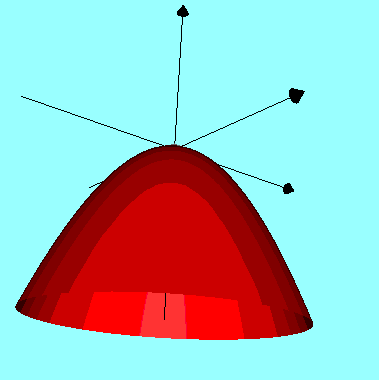
\[ -2x = 0 \implies x = 0 \] \[ -2y = 0 \implies y = 0 \]La solution est le couple ordonné \( (0, 0) \).
Le graphique de \( f(x, y) = -x^2 - y^2 \) est présenté ci-dessous, illustrant un maximum relatif.
Exemple 4
Trouvez le ou les points critiques de la fonction \( f \) définie par :
\[ f(x, y) = x^3 + 3x^2 - 9x + y^3 - 12y \]Afficher la solution de l'exemple 4
Les dérivées partielles du premier ordre sont données par :
\[ f_x(x, y) = 3x^2 + 6x - 9 \] \[ f_y(x, y) = 3y^2 - 12 \]Nous résolvons maintenant simultanément les équations \( f_x(x, y) = 0 \) et \( f_y(x, y) = 0 \) :
\[ 3x^2 + 6x - 9 = 0 \implies 3(x + 3)(x - 1) = 0 \implies x = -3 \text{ ou } x = 1 \] \[ 3y^2 - 12 = 0 \implies 3(y^2 - 4) = 0 \implies y = -2 \text{ ou } y = 2 \]En combinant toutes les combinaisons possibles de \( x \) et \( y \), les points critiques sont :
\[ (1, 2), \; (1, -2), \; (-3, 2), \; (-3, -2) \]Exercices
Trouvez, s'il y en a, les points critiques des fonctions ci-dessous. Cliquez sur chaque exercice pour vérifier vos réponses.
Exercice 1
\( f(x, y) = 3xy - x^3 - y^3 \)
Afficher la réponse
Exercice 2
\( f(x, y) = e^{-x^2 - y^2 + 2x - 2y - 2} \)
Afficher la réponse
Exercice 3
\( f(x, y) = \dfrac{1}{2}x^2 + y^3 - 3xy - 4x + 2 \)
Afficher la réponse
Exercice 4
\( f(x, y) = x^3 + y^3 + 2x + 6y \)