Plusieurs problèmes d'optimisation sont résolus et des solutions détaillées sont présentées. Ces problèmes impliquent l'optimisation de fonctions de deux variables à l'aide de dérivées partielles du premier et du second ordre.
Dans ce qui suit, \( C \) représente la constante d'intégration le cas échéant.
Problèmes avec solutions détaillées
Cliquez sur chaque problème pour afficher sa solution détaillée étape par étape.
Problème 1
Vous décidez de construire une boîte en forme de pavé droit d'un volume de 1000 centimètres cubes. Trouvez les dimensions \( x \), \( y \) et \( z \) de la boîte de sorte que la surface totale des 6 faces soit minimisée.
Afficher la solution du problème 1
La surface totale \( A \) des six faces du pavé droit est donnée par :
\[ A = 2xy + 2yz + 2zx \]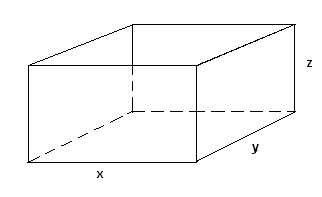
Le volume de la boîte est donné comme valant 1000 :
\[ xyz = 1000 \implies z = \frac{1000}{xy} \]Substituez \( z \) dans la formule de l'aire totale pour exprimer \( A \) en fonction de deux variables \( x \) et \( y \) :
\[ A(x,y) = 2xy + 2y\left(\frac{1000}{xy}\right) + 2x\left(\frac{1000}{xy}\right) = 2xy + \frac{2000}{x} + \frac{2000}{y} \]Pour trouver les points critiques, calculez les dérivées partielles du premier ordre et posez-les égales à zéro :
\[ A_x(x,y) = 2y - \frac{2000}{x^2} = 0 \] \[ A_y(x,y) = 2x - \frac{2000}{y^2} = 0 \]La résolution de ce système donne la solution physique positive :
\[ x = 10, \quad y = 10 \]Ensuite, trouvez les dérivées partielles du second ordre :
\[ A_{xx}(x,y) = \frac{4000}{x^3}, \quad A_{yy}(x,y) = \frac{4000}{y^3}, \quad A_{xy}(x,y) = 2 \]Évaluez \( D = A_{xx}A_{yy} - A_{xy}^2 \) en \( (10, 10) \) :
\[ D = \left(\frac{4000}{1000}\right)\left(\frac{4000}{1000}\right) - (2)^2 = (4)(4) - 4 = 12 \]Puisque \( D = 12 > 0 \) et \( A_{xx}(10,10) = 4 > 0 \), l'aire \( A \) est minimisée lorsque :
\[ x = 10 \, \text{cm}, \quad y = 10 \, \text{cm}, \quad z = \frac{1000}{(10)(10)} = 10 \, \text{cm} \]Problème 2
Trouvez les dimensions d'une boîte à six faces en forme de pavé droit ayant le plus grand volume possible qui puisse être fabriquée en utilisant 12 mètres carrés de carton.
Afficher la solution du problème 2
En utilisant tout le carton disponible, la surface totale \( A \) est fixée à 12 :
\[ A = 2xy + 2yz + 2zx = 12 \]
Le volume \( V \) à maximiser est :
\[ V = xyz \]Isolez \( z \) dans l'équation de la surface totale :
\[ z = \frac{6 - xy}{x + y} \]Substituez \( z \) dans la formule du volume :
\[ V(x,y) = \frac{xy(6 - xy)}{x + y} = \frac{6xy - x^2y^2}{x + y} \]Trouvez les dérivées partielles du premier ordre :
\[ V_x(x,y) = -y^2 \frac{x^2 + 2xy - 6}{(x + y)^2} \] \[ V_y(x,y) = -x^2 \frac{y^2 + 2xy - 6}{(x + y)^2} \]En posant \( V_x = 0 \) et \( V_y = 0 \), on obtient les équations critiques intérieures :
\[ x^2 + 2xy - 6 = 0, \quad y^2 + 2xy - 6 = 0 \]La soustraction des équations donne \( x^2 - y^2 = 0 \implies x = y \) (puisque les dimensions doivent être positives). En substituant \( x = y \) dans \( x^2 + 2x^2 - 6 = 0 \) :
\[ 3x^2 = 6 \implies x^2 = 2 \implies x = \sqrt{2}, \; y = \sqrt{2} \]Ainsi, le point critique est \( (\sqrt{2}, \sqrt{2}) \).
Calcul des dérivées partielles du second ordre :
En appliquant la règle du quotient sur \( V_x \) et \( V_y \), nous trouvons les dérivées partielles du second ordre :
\[ V_{xx}(x,y) = \frac{\partial}{\partial x}\left[ -y^2 \frac{x^2 + 2xy - 6}{(x + y)^2} \right] = -2y^2 \frac{y^2 + 6}{(x + y)^3} \] \[ V_{yy}(x,y) = \frac{\partial}{\partial y}\left[ -x^2 \frac{y^2 + 2xy - 6}{(x + y)^2} \right] = -2x^2 \frac{x^2 + 6}{(x + y)^3} \] \[ V_{xy}(x,y) = \frac{\partial}{\partial x}\left[ -y^2 \frac{x^2 + 2xy - 6}{(x + y)^2} \right] = -2xy \frac{x^2 + 3xy + y^2 - 6}{(x + y)^3} \]Évaluation au point critique \( (\sqrt{2}, \sqrt{2}) \) :
- \( V_{xx}(\sqrt{2}, \sqrt{2}) = -2(\sqrt{2})^2 \frac{(\sqrt{2})^2 + 6}{(\sqrt{2} + \sqrt{2})^3} = -2(2)\frac{2 + 6}{(2\sqrt{2})^3} = -4\frac{8}{16\sqrt{2}} = -\frac{32}{16\sqrt{2}} = -\frac{2}{\sqrt{2}} = -\sqrt{2} \)
- Par symétrie, \( V_{yy}(\sqrt{2}, \sqrt{2}) = -\sqrt{2} \)
- \( V_{xy}(\sqrt{2}, \sqrt{2}) = -2(\sqrt{2})(\sqrt{2}) \frac{(\sqrt{2})^2 + 3(\sqrt{2})(\sqrt{2}) + (\sqrt{2})^2 - 6}{(2\sqrt{2})^3} = -4\frac{2 + 6 + 2 - 6}{16\sqrt{2}} = -4\frac{4}{16\sqrt{2}} = -\frac{16}{16\sqrt{2}} = -\frac{1}{\sqrt{2}} = -\frac{\sqrt{2}}{2} \)
Application du test de la dérivée seconde :
Calculez le discriminant \( D = V_{xx}V_{yy} - V_{xy}^2 \) en \( (\sqrt{2}, \sqrt{2}) \) :
\[ D = \left(-\sqrt{2}\right)\left(-\sqrt{2}\right) - \left(-\frac{\sqrt{2}}{2}\right)^2 = 2 - \frac{2}{4} = 2 - \frac{1}{2} = \frac{3}{2} \]Puisque \( D = \dfrac{3}{2} > 0 \) et \( V_{xx}(\sqrt{2},\sqrt{2}) = -\sqrt{2} < 0 \), le volume est maximisé lorsque :
\[ x = \sqrt{2} \, \text{mètres}, \quad y = \sqrt{2} \, \text{mètres}, \quad z = \frac{6 - (\sqrt{2})(\sqrt{2})}{\sqrt{2} + \sqrt{2}} = \frac{4}{2\sqrt{2}} = \sqrt{2} \, \text{mètres} \]Problème 3
Trouvez la distance du point \( (1, 2, -1) \) au plan donné par l'équation \( x - y + z = 3 \).
Afficher la solution du problème 3
Pour trouver la distance d'un point à un plan, nous pouvons minimiser le carré de la distance entre \( (1, 2, -1) \) et un point arbitraire \( (x, y, z) \) sur le plan :
\[ f(x,y,z) = (x - 1)^2 + (y - 2)^2 + (z + 1)^2 \]Isolez \( z \) dans l'équation du plan \( x - y + z = 3 \) :
\[ z = 3 - x + y \]Substituez \( z \) dans \( f \) pour l'exprimer comme une fonction de \( x \) et \( y \) :
\[ F(x,y) = (x - 1)^2 + (y - 2)^2 + (-x + y + 4)^2 \]Trouvez les dérivées partielles du premier ordre :
\[ F_x(x,y) = 2(x - 1) + 2(-1)(-x + y + 4) = 4x - 2y - 10 \] \[ F_y(x,y) = 2(y - 2) + 2(1)(-x + y + 4) = -2x + 4y + 4 \]En posant les dérivées partielles égales à zéro et en résolvant le système, on obtient le point critique :
\[ \left(\frac{8}{3}, \frac{1}{3}\right) \]La coordonnée \( z \) correspondante sur le plan est :
\[ z = 3 - \frac{8}{3} + \frac{1}{3} = \frac{2}{3} \]Le test de la dérivée seconde donne \( D = (4)(4) - (-2)^2 = 12 > 0 \) et \( F_{xx} = 4 > 0 \), ce qui confirme un minimum en \( \left(\frac{8}{3}, \frac{1}{3}, \frac{2}{3}\right) \).
La plus courte distance \( d \) est :
\[ d = \sqrt{\left(1 - \frac{8}{3}\right)^2 + \left(2 - \frac{1}{3}\right)^2 + \left(-1 - \frac{2}{3}\right)^2} = \sqrt{\left(-\frac{5}{3}\right)^2 + \left(\frac{5}{3}\right)^2 + \left(-\frac{5}{3}\right)^2} = \sqrt{\frac{25}{9} + \frac{25}{9} + \frac{25}{9}} = \sqrt{\frac{75}{9}} = \frac{5\sqrt{3}}{3} = \frac{5}{\sqrt{3}} \]