Convert Logarithms and Exponentials
Understanding how to convert between logarithmic and exponential forms is essential for solving complex mathematical equations. Below, we review the fundamental relationship between these two functions and provide step-by-step examples of conversions.
Table of Contents
Relationship Between Exponential and Logarithmic Functions
The logarithmic functions and the exponential functions are inverses of each other. Because of this, an equation written in logarithmic form can always be rewritten in exponential form, and vice versa.
Where \( b \) is the common base of both the exponential and the logarithm (\( b \gt 0 \) and \( b \neq 1 \)), and \( x \gt 0 \).
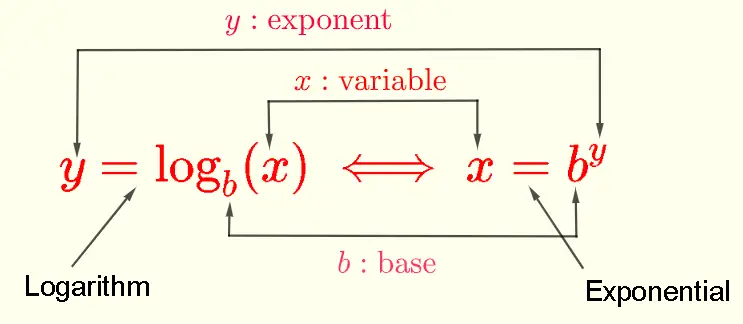
This equivalence is the key to solving logarithmic and exponential equations. Let's look at examples of how this relationship is used to transform expressions.
Inverse Function Identities
Because logarithms and exponentials are inverses, the following identities hold:
- \( \log_b(b^x) = x \) for all real \( x \)
- \( b^{\log_b(x)} = x \) for all \( x \gt 0 \)
These identities confirm the inverse relationship and are useful when simplifying complex expressions.
Quick Conversion Reference Table
The following table summarizes how each part of the logarithmic form maps to the exponential form:
| Logarithmic Form | Exponential Form | Component |
|---|---|---|
| \( \log_b(x) = y \) | \( b^y = x \) | Base \( b \), exponent \( y \), result \( x \) |
| \( \log_2(8) = 3 \) | \( 2^3 = 8 \) | Base 2, exponent 3 |
| \( \log_{10}(100) = 2 \) | \( 10^2 = 100 \) | Base 10, exponent 2 |
| \( \ln(e) = 1 \) | \( e^1 = e \) | Base \( e \), exponent 1 |
| \( \log_5(1) = 0 \) | \( 5^0 = 1 \) | Base 5, exponent 0 |
How to Convert: Step-by-Step Method
- Identify the three quantities: base \( b \), exponent \( y \), and result \( x \).
- If converting from log to exponential: Write \( b^y = x \). The base of the logarithm becomes the base of the exponential; the value on the right side of the log equation becomes the exponent; the argument of the logarithm becomes the result.
- If converting from exponential to log: Write \( \log_b(x) = y \). The base of the exponential becomes the base of the logarithm; the result of the exponential becomes the argument; the exponent becomes the value of the logarithm.
- Verify the domain: Ensure \( b \gt 0 \), \( b \ne 1 \), and \( x \gt 0 \).
Memory aid: The base stays the same. The exponent and result swap roles between the two forms.
Conversion Examples
Example 1: Change Logarithms to Exponentials
Show Solution
Question: Change each logarithmic expression to an exponential expression.
- \( \log_3 27 = 3 \)
- \( \log_{36} 6 = \frac{1}{2} \)
- \( \log_2 \left(\frac{1}{8}\right) = -3 \)
- \( \log_8 2 = \frac{1}{3} \)
Solution
- The logarithmic form \( \log_3 27 = 3 \) has a base of \( 3 \). In exponential form: \[ 3^3 = 27 \]
Verification: \( 3^3 = 27 \) ✓ - The logarithmic expression \( \log_{36} 6 = \frac{1}{2} \) has a base of \( 36 \). In exponential form: \[ 36^{1/2} = 6 \]
Verification: \( \sqrt{36} = 6 \) ✓ - The expression \( \log_2 \left(\frac{1}{8}\right) = -3 \) has a base of \( 2 \). In exponential form: \[ 2^{-3} = \frac{1}{8} \]
Verification: \( 2^{-3} = \frac{1}{2^3} = \frac{1}{8} \) ✓ - The expression \( \log_8 2 = \frac{1}{3} \) has a base of \( 8 \). In exponential form: \[ 8^{1/3} = 2 \]
Verification: \( \sqrt[3]{8} = 2 \) ✓
Example 2: Change Exponentials to Logarithms
Show Solution
Question: Change each exponential expression to a logarithmic expression.
- \( 3^4 = 81 \)
- \( 4^{1/2} = 2 \)
- \( 3^{-3} = \frac{1}{27} \)
- \( 10^3 = 1000 \)
Solution
- The exponential form \( 3^4 = 81 \) uses a base of \( 3 \). In logarithmic form: \[ \log_3 (81) = 4 \]
Verification: \( 3^4 = 81 \) ✓ - The exponential form \( 4^{1/2} = 2 \) uses a base of \( 4 \). In logarithmic form: \[ \log_4 (2) = \frac{1}{2} \]
Verification: \( 4^{1/2} = 2 \) ✓ - The exponential form \( 3^{-3} = \frac{1}{27} \) uses a base of \( 3 \). In logarithmic form: \[ \log_3 \left(\frac{1}{27}\right) = -3 \]
Verification: \( 3^{-3} = \frac{1}{27} \) ✓ - The exponential form \( 10^3 = 1000 \) uses a base of \( 10 \). In logarithmic form: \[ \log_{10} (1000) = 3 \]
Verification: \( 10^3 = 1000 \) ✓
Example 3: Solving Equations using Conversion
Show Solution
Question: Solve for \( x \) in the following equations.
- \( \log_3 x = 5 \)
- \( \log_2 (x - 3) = 2 \)
- \( 2 \log_3 (-x + 1) = 6 \)
Solution
- To solve \( \log_3 x = 5 \), rewrite into exponential form: \[ x = 3^5 \]
Evaluate the exponent: \[ x = 243 \]
Verification: \( \log_3(243) = \log_3(3^5) = 5 \) ✓ - Rewrite \( \log_2 (x - 3) = 2 \) into its equivalent exponential form: \[ x - 3 = 2^2 \]
\[ x - 3 = 4 \]
Solve for \( x \): \[ x = 7 \]
Verification: \( \log_2(7-3) = \log_2(4) = 2 \) ✓. Also \( x - 3 = 4 \gt 0 \) ✓ - First, divide all terms of \( 2 \log_3 (-x + 1) = 6 \) by \( 2 \) to isolate the logarithm: \[ \log_3 (-x + 1) = 3 \]
Rewrite the simplified equation in exponential form: \[ -x + 1 = 3^3 \]
\[ -x + 1 = 27 \]
Solve for \( x \): \[ -x = 26 \quad \Rightarrow \quad x = -26 \]
Verification: \( \log_3(-(-26) + 1) = \log_3(27) = 3 \) ✓. Also \( -x + 1 = 27 \gt 0 \) ✓
Example 4: Working with Natural Logarithms
Show Solution
Question: Convert each of the following between logarithmic and exponential form, using \( e \approx 2.71828 \).
- \( \ln(x) = 2 \)
- \( e^{3} = y \)
- \( \ln\left(\frac{1}{e}\right) = -1 \)
Solution
- Since \( \ln(x) = \log_e(x) \), the equation \( \ln(x) = 2 \) becomes: \[ e^2 = x \]
Numerically, \( x \approx 7.389 \) - The equation \( e^3 = y \) becomes: \[ \ln(y) = 3 \]
Numerically, \( y \approx 20.086 \) - The equation \( \ln\left(\frac{1}{e}\right) = -1 \) becomes: \[ e^{-1} = \frac{1}{e} \]
Verification: \( e^{-1} = \frac{1}{e} \approx 0.3679 \) ✓
Example 5: Solving an Exponential Equation with Conversion
Show Solution
Question: Solve \( 5^{2x - 1} = 125 \) for \( x \).
Solution
Notice that \( 125 = 5^3 \), hence \( 5^{2x - 1} = 5^3 \). Since both sides have the same base 5, we can equate exponents directly:
\[ 2x - 1 = 3 \] \[ 2x = 4 \] \[ x = 2 \]Alternative method using conversion: Convert to logarithmic form:
\[ \log_5(125) = 2x - 1 \]Since \( \log_5(125) = \log_5(5^3) = 3 \):
\[ 3 = 2x - 1 \implies 2x = 4 \implies x = 2 \]Verification: \( 5^{2(2) - 1} = 5^3 = 125 \) ✓
Common Mistakes to Avoid
- Confusing base with argument. In \( \log_b(x) = y \), \( b \) is the base (which becomes the base of the exponential), and \( x \) is the argument (which becomes the result).
- Forgetting the domain condition. The argument \( x \) of a logarithm must be strictly positive. After solving, always check that the solution satisfies the domain.
- Using a negative base. The base \( b \) must be positive and not equal to 1. \( \log_{-2}(8) \) is undefined, even though \( (-2)^3 = -8 \).
- Confusing \( \log \) and \( \ln \). \( \log(x) \) usually means base 10, while \( \ln(x) \) means base \( e \). They are not interchangeable.
- Misplacing the exponent. In \( \log_3 27 = 3 \), the exponent is 3, and 27 is the result. Do not write \( 3^{27} = 3 \).
Practice Exercises
Try converting each expression on your own before checking the answers below.
Convert to Exponential Form
- \( \log_4(64) = 3 \)
- \( \log_7(1) = 0 \)
- \( \log_{10}(0.01) = -2 \)
- \( \ln(1) = 0 \)
Convert to Logarithmic Form
- \( 2^6 = 64 \)
- \( 9^{1/2} = 3 \)
- \( 10^{-3} = 0.001 \)
- \( e^0 = 1 \)
View All Answers
To exponential form:
- \( \log_4(64) = 3 \iff 4^3 = 64 \)
- \( \log_7(1) = 0 \iff 7^0 = 1 \)
- \( \log_{10}(0.01) = -2 \iff 10^{-2} = 0.01 \)
- \( \ln(1) = 0 \iff e^0 = 1 \)
To logarithmic form:
- \( 2^6 = 64 \iff \log_2(64) = 6 \)
- \( 9^{1/2} = 3 \iff \log_9(3) = \frac{1}{2} \)
- \( 10^{-3} = 0.001 \iff \log_{10}(0.001) = -3 \)
- \( e^0 = 1 \iff \ln(1) = 0 \)
Frequently Asked Questions
How do you convert a logarithm to exponential form?
To convert \( \log_b(x) = y \) to exponential form, use the rule \( b^y = x \). The base of the logarithm becomes the base of the exponential, the exponent becomes the value of the logarithm, and the argument becomes the result.
How do you convert an exponential to logarithmic form?
To convert \( b^y = x \) to logarithmic form, use the rule \( \log_b(x) = y \). The base of the exponential becomes the base of the logarithm, the result becomes the argument of the logarithm, and the exponent becomes the value of the logarithm.
What are the conditions on the base in log-exponential conversion?
The base \( b \) must satisfy \( b \gt 0 \) and \( b \ne 1 \). Also, in \( \log_b(x) = y \), the argument \( x \) must be positive (\( x \gt 0 \)). These conditions are required because logarithmic functions are only defined for positive arguments and valid bases.
Why are logarithms and exponentials inverses of each other?
Logarithms and exponentials are inverses because composing one with the other returns the original input: \( \log_b(b^x) = x \) for all real \( x \), and \( b^{\log_b(x)} = x \) for all \( x \gt 0 \). This inverse relationship is what makes the conversion rule work.
How do you solve a logarithmic equation using conversion?
To solve \( \log_b(\text{expression}) = y \): (1) rewrite as \( b^y = \text{expression} \), (2) simplify the exponential, (3) solve the resulting algebraic equation for the variable. Always verify the solution satisfies the domain condition (the argument must be positive).
What is the difference between \( \log \) and \( \ln \)?
\( \log(x) \) usually means log base 10 (common logarithm), while \( \ln(x) \) means log base \( e \) (natural logarithm, where \( e \approx 2.71828 \)). The conversion rule applies identically to both: \( y = \ln(x) \) is equivalent to \( e^y = x \).
More References and Links Related to Logarithmic Functions
- Logarithm and Exponential Questions with Answers and Solutions
- Rules of Logarithms and Exponentials - Questions with Solutions
- Change of Base Formula for Logarithms
- Find Logarithmic Functions from Graphs
- Logarithmic Functions Introduction
- Exponential Functions
- Precalculus - Mathematics for Calculus - 7th Edition - James Stewart, Lothar Redlin, Saleem Watson
- Algebra and Trigonometry - 10th Edition - Michael Sullivan