-
Evaluate the limit:
\[ \lim_{h \to 0} \frac{e^{4} e^{h} - e^{4}}{h} = \]
A) \(e\)
B) \(1\)
C) \(e^h\)
D) \(e^4\)
E) \(4^e\)View Answer and Detailed Solution
Correct Answer: D
As \(h \to 0\), direct substitution gives the indeterminate form \( \frac{0}{0} \).
Let \( f(x) = e^{x} \). The limit can be rewritten as:
\[ \lim_{h \to 0} \frac{e^{4+h} - e^{4}}{h} = \lim_{h \to 0} \frac{f(4+h) - f(4)}{h} \]This is the definition of the derivative of \( f(x) = e^{x} \) at \(x = 4\). Therefore,
\[ \lim_{h \to 0} \frac{e^{4} e^{h} - e^{4}}{h} = f'(4) = e^{4} \] -
The function \(g\) defined by \[ g(x) = \frac{x^{3} + 2x^{2} - 3x}{x^{2} + 2x - 3} \] has vertical asymptotes at:
A) \(x = 1, -3\)
B) \(x = 0\)
C) \(x = 1\)
D) \(x = -3\)
E) Function \(g\) has no vertical asymptotesView Answer and Detailed Solution
Correct Answer: E
Factor and simplify the rational function:
\[ g(x) = \frac{x(x^{2} + 2x - 3)}{x^{2} + 2x - 3} = x \]The simplified function \(g(x) = x\) has no vertical asymptotes.
-
Given \[ \lim_{x \to 0} \frac{\sin x}{x} = 1 \] find \[ \lim_{x \to 0} \frac{x + 4x^{2} + \sin x}{3x} \]
A) \(\frac{2}{3}\)
B) \(\frac{4}{3}\)
C) \(\frac{1}{3}\)
D) \(2\)
E) Does not existView Answer and Detailed Solution
Correct Answer: A
Using the limit sum rule:
\[ \begin{aligned} \lim_{x \to 0} \frac{x + 4x^{2} + \sin x}{3x} &= \lim_{x \to 0} \left( \frac{x}{3x} + \frac{4x^{2}}{3x} + \frac{\sin x}{3x} \right) \\ &= \lim_{x \to 0} \frac{1}{3} + \lim_{x \to 0} \frac{4x}{3} + \frac{1}{3} \lim_{x \to 0} \frac{\sin x}{x} \\ &= \frac{1}{3} + 0 + \frac{1}{3}(1) = \frac{2}{3} \end{aligned} \] -
Function \(f\) is defined by \[ f(x) = 2x^{3}\sin(x) + \frac{1}{x}\tan(x) + x\sec(x) + 2 \] find \(f'(x)\).
A) \(6x^2 \sin(x) - \frac{1}{x^2}\tan(x) + \sec(x)\)
B) \(6x^2 \sin(x) + 2x^3 \cos(x) - \frac{1}{x^2}\tan(x) + \frac{1}{x} \sec^2(x) + \sec(x) + x \sin(x) \sec^2(x)\)
C) \(2x^3 \cos(x) + \frac{1}{x} \sec^2(x) + x \sin(x) \sec^2(x)\)
D) \(6x^2 \cos(x) - \frac{1}{x^2} \sec^2(x) + \sec^2(x)\)
E) \(6x^2 \sin(x) + 2x^3 \cos(x) - \frac{1}{x^2}\tan(x) + \frac{1}{x} \sec^2(x) + \sec(x) + x \sin(x) \sec^2(x) + 2\)View Answer and Detailed Solution
Correct Answer: B
Differentiate term by term:
\[ \begin{aligned} f'(x) &= \frac{d}{dx}[2x^{3}\sin(x)] + \frac{d}{dx}\left[\frac{1}{x}\tan(x)\right] + \frac{d}{dx}[x\sec(x)] + \frac{d}{dx}[2] \\[4pt] &= 2[3x^{2}\sin(x) + x^{3}\cos(x)] + \left[-\frac{1}{x^{2}}\tan(x) + \frac{1}{x}\sec^{2}(x)\right] + [\sec(x) + x\sin(x)\sec^{2}(x)] + 0 \\[4pt] &= 6x^{2}\sin(x) + 2x^{3}\cos(x) - \frac{1}{x^{2}}\tan(x) + \frac{1}{x}\sec^{2}(x) + \sec(x) + x\sin(x)\sec^{2}(x) \end{aligned} \] -
Curve \(C\) is described by \(0.25x^2 + y^2 = 9\). Determine the \(y\)-coordinates where the tangent line has slope \(1\).
A) \(-\frac{3\sqrt{5}}{5}, \frac{3\sqrt{5}}{5}\)
B) \(-\frac{\sqrt{35}}{2}, \frac{\sqrt{35}}{2}\)
C) \(-3, 3\)
D) \(-\frac{\sqrt{2}}{2}, \frac{\sqrt{2}}{2}\)
E) \(-3\sqrt{2}, 3\sqrt{2}\)View Answer and Detailed Solution
Correct Answer: A
Implicit differentiation:
\[ 0.5x + 2y y' = 0 \Rightarrow y' = -\frac{0.5x}{2y} = -\frac{x}{4y} \]Set \(y' = 1\):
\[ -\frac{x}{4y} = 1 \Rightarrow x = -4y \]Substitute into original equation:
\[ 0.25(-4y)^{2} + y^{2} = 9 \Rightarrow 4y^{2} + y^{2} = 9 \Rightarrow 5y^{2} = 9 \Rightarrow y = \pm\frac{3\sqrt{5}}{5} \]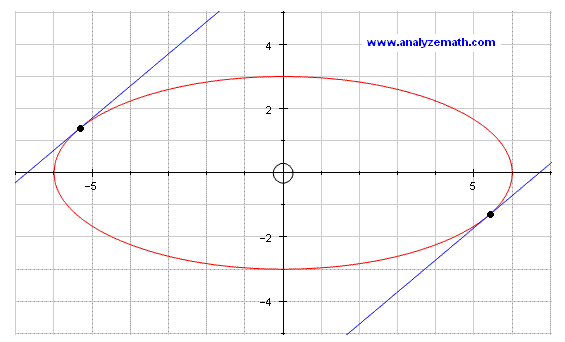
-
Solve the differential equation \(\frac{dy}{dx} = \frac{\cos x}{y^2}\) with \(y(\pi/2) = 0\).
A) \(y = 3 \sin x - 3\)
B) \(y = \sin x - 1\)
C) \(y = \sqrt[3]{3 \sin x - 3}\)
D) \(y = (3 \sin x - 3)^3\)
E) \(y = \frac{1}{\sqrt[3]{3 \sin x - 3}}\)View Answer and Detailed Solution
Correct Answer: C
Separate variables:
\[ y^{2} \, dy = \cos x \, dx \]Integrate both sides:
\[ \int y^{2} \, dy = \int \cos x \, dx \Rightarrow \frac{1}{3}y^{3} = \sin x + C \]Apply initial condition \(y(\pi/2) = 0\):
\[ \frac{1}{3}(0)^{3} = \sin\left(\frac{\pi}{2}\right) + C \Rightarrow 0 = 1 + C \Rightarrow C = -1 \]Solve for \(y\):
\[ \frac{1}{3}y^{3} = \sin x - 1 \Rightarrow y^{3} = 3(\sin x - 1) \Rightarrow y = \sqrt[3]{3\sin x - 3} \] -
Evaluate:
\[ \int \sin^4 x \cos x \, dx = \]
A) \(\cos^5 x + C\)
B) \(-\frac{1}{5}\sin^5 x + C\)
C) \(\sin^5 x + C\)
D) \(\frac{1}{5}\sin^5 x + C\)
E) \(-5\cos^5 x + C\)View Answer and Detailed Solution
Correct Answer: D
Use substitution \(u = \sin x\), \(du = \cos x \, dx\):
\[ \int \sin^{4} x \cos x \, dx = \int u^{4} \, du = \frac{1}{5}u^{5} + C = \frac{1}{5}\sin^{5} x + C \] -
Find:
\[ \frac{d}{dx} \int_{3}^{2x} \sin(t^2 + 1) \, dt = \]
A) \(2 \sin(4x^2 + 1)\)
B) \(2 \sin(x^2 + 1)\)
C) \(\sin(x^2 + 1)\)
D) \(2 \sin(4x^2 + 1) - 2 \sin(3^2 + 1)\)
E) \(2 \sin(4x^2)\)View Answer and Detailed Solution
Correct Answer: A
Apply the Fundamental Theorem of Calculus with the chain rule:
\[ \frac{d}{dx} \int_{3}^{2x} \sin(t^{2} + 1) \, dt = \sin((2x)^{2} + 1) \cdot \frac{d}{dx}(2x) = 2\sin(4x^{2} + 1) \] -
Evaluate:
\[ \int_{0}^{10} \left(|4 - x| + |2 - 2x|\right)dx = \]
A) \(100\)
B) \(108\)
C) \(110\)
D) \(112\)
E) \(114\)View Answer and Detailed Solution
Correct Answer: B
Break at points where expressions change sign: \(x = 4\) for \(|4-x|\) and \(x=1\) for \(|2-2x|\):
\[ \begin{aligned} \int_{0}^{10} |4-x| \, dx &= \int_{0}^{4} (4-x) \, dx + \int_{4}^{10} (x-4) \, dx = 8 + 18 = 26 \\[4pt] \int_{0}^{10} |2-2x| \, dx &= \int_{0}^{1} (2-2x) \, dx + \int_{1}^{10} (2x-2) \, dx = 1 + 81 = 82 \end{aligned} \]Sum the results:
\[ 26 + 82 = 108 \] -
Evaluate:
\[ \int \frac{(5 + x^{3/4})^{9}}{x^{1/4}}dx = \]
A) \((5 + x^{3/4})^{10}\)
B) \((x^{3/4})^{10}\)
C) \(\frac{1}{10}(5 + x^{3/4})^{10}\)
D) \(\frac{1}{10} \frac{(5 + x^{3/4})^{10}}{x^{1/4}}\)
E) \(\frac{2}{15}(5 + x^{3/4})^{10}\)View Answer and Detailed Solution
Correct Answer: E
Use substitution \(u = 5 + x^{3/4}\), \(du = \frac{3}{4}x^{-1/4} \, dx\):
\[ \int \frac{(5 + x^{3/4})^{9}}{x^{1/4}} \, dx = \frac{4}{3} \int u^{9} \, du = \frac{4}{3} \cdot \frac{u^{10}}{10} + C = \frac{2}{15}(5 + x^{3/4})^{10} + C \] -
Given \[ h(x) = (\arctan(x^3 + 1) + 2x)^4\], find \(h'(x)\).
A) \(\frac{3x^2}{x^6 + 2x^3 + 2} + 2\)
B) \(4(\arctan(x^3 + 1) + 2x)^3 \cdot \left( \frac{3x^2}{x^6 + 2x^3 + 2} \right)\)
C) \(4(\arctan(x^3 + 1) + 2x)^3\)
D) \(4(\arctan(x^3 + 1) + 2x)^3 \cdot \left( \frac{3x^2}{x^6 + 2x^3 + 2} + 2 \right)\)
E) \(\frac{1}{4}(\arctan(x^3 + 1) + 2x)^3\)View Answer and Detailed Solution
Correct Answer: D
Apply the chain rule:
\[ \begin{aligned} h'(x) &= 4[\arctan(x^{3}+1) + 2x]^{3} \cdot \frac{d}{dx}[\arctan(x^{3}+1) + 2x] \\ &= 4[\arctan(x^{3}+1) + 2x]^{3} \cdot \left[ \frac{3x^{2}}{1 + (x^{3}+1)^{2}} + 2 \right] \\ &= 4[\arctan(x^{3}+1) + 2x]^{3} \cdot \frac{3x^{2} + 2(x^{6} + 2x^{3} + 2)}{x^{6} + 2x^{3} + 2} \end{aligned} \] -
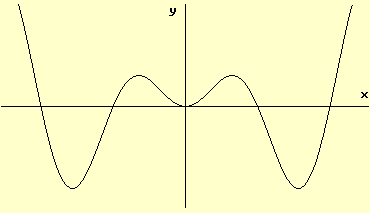
The graph of function \(h\) is shown below. How many zeros does \(h'\) have?
A) \(1\)
B) \(2\)
C) \(3\)
D) \(4\)
E) \(5\)View Answer and Detailed Solution
Correct Answer: E
\(h'(x) = 0\) at local extrema. The graph shows 3 local minima and 2 local maxima, so \(h'\) has 5 zeros.
-
The graph of a polynomial \(f\) is shown. If we divide \(f'(x)\) by \(x - b\), the remainder is most likely:

A) \(f(b)\)
B) \(1\)
C) \(0\)
D) \(2\)
E) \(-1\)View Answer and Detailed Solution
Correct Answer: C
Since \(f\) has a local maximum at \(x = b\), \(f'(b) = 0\). By the Remainder Theorem, the remainder when \(f'(x)\) is divided by \((x-b)\) is \(f'(b) = 0\).
-
The parametric curve \((\ln(t - 2), 3t)\) for \(t > 2\) represents:
A) \(y = \ln\left(\frac{x}{3} - 2\right)\)
B) \(y = 3x\)
C) \(x = \ln(y - 2)\)
D) \(y = 3(e^x + 2)\)
E) \(y = \ln(x)\)View Answer and Detailed Solution
Correct Answer: D
From parametric equations: \(x = \ln(t-2)\), \(y = 3t\). Solve for \(t\) from \(y\): \(t = y/3\). Substitute into \(x\):
\[ x = \ln\left(\frac{y}{3} - 2\right) \Rightarrow e^{x} = \frac{y}{3} - 2 \Rightarrow y = 3(e^{x} + 2) \] -
Let \(P(x) = 2x^3 + Kx + 1\). Find \(K\) if the remainder when dividing \(P(x)\) by \(x - 2\) is \(10\).
A) \(-\frac{7}{2}\)
B) \(\frac{2}{7}\)
C) \(\frac{7}{2}\)
D) \(-\frac{2}{7}\)
E) \(K\) cannot be determinedView Answer and Detailed Solution
Correct Answer: A
By the Remainder Theorem: \(P(2) = 10\):
\[ 2(2)^{3} + K(2) + 1 = 10 \Rightarrow 16 + 2K + 1 = 10 \Rightarrow 2K = -7 \Rightarrow K = -\frac{7}{2} \] -
Function \(f\) is defined by: \[ f(x) = \begin{cases} \dfrac{\sqrt{4x + 4} - \sqrt{2x + 4}}{2x}, \\\\ C \end{cases} \] What value of \(C\) makes \(f\) continuous at \(x = 0\)?
A) \(0\)
B) \(\frac{1}{4}\)
C) \(\frac{1}{8}\)
D) \(1\)
E) Any real numberView Answer and Detailed Solution
Correct Answer: B
Rationalize the numerator:
\[ \begin{aligned} \lim_{x \to 0} f(x) &= \lim_{x \to 0} \frac{(\sqrt{4x+4} - \sqrt{2x+4})(\sqrt{4x+4} + \sqrt{2x+4})}{2x(\sqrt{4x+4} + \sqrt{2x+4})} \\ &= \lim_{x \to 0} \frac{(4x+4) - (2x+4)}{2x(\sqrt{4x+4} + \sqrt{2x+4})} \\ &= \lim_{x \to 0} \frac{2x}{2x(\sqrt{4x+4} + \sqrt{2x+4})} = \frac{1}{\sqrt{4}+\sqrt{4}} = \frac{1}{4} \end{aligned} \]For continuity, \(C = \frac{1}{4}\).
-
Given \(f'(x) = g(x)\) and \(g'(x) = f(x)\), the second derivative of \((f \cdot g)(x)\) is:
A) \(f''(x)g''(x)\)
B) \(g'(x)g(x) + f(x)f'(x)\)
C) \(4g(x)f(x)\)
D) \(2g(x)f(x)\)
E) \(g(x)f(x)\)View Answer and Detailed Solution
Correct Answer: C
First derivative using the product rule:
\[ (f \cdot g)' = f'g + fg' = g^{2} + f^{2} \]Second derivative:
\[ (f \cdot g)'' = 2gg' + 2ff' = 2gf + 2fg = 4fg \] -
The average rate of change of \(f(x) = \sin x + x\) on \([0, \pi]\) is:
A) \(0\)
B) \(2\pi\)
C) \(\pi\)
D) \(2\)
E) \(1\)View Answer and Detailed Solution
Correct Answer: E
Average rate of change formula:
\[ \frac{f(\pi) - f(0)}{\pi - 0} = \frac{(\sin\pi + \pi) - (\sin 0 + 0)}{\pi} = \frac{\pi}{\pi} = 1 \] -
Find the area of the shaded region below \(y = \sin x\) and \(y = \frac{1}{2}\) on \([0, \pi]\):

A) \(1\)
B) \(0.5\)
C) \(2 + \frac{\pi}{3}\)
D) \(2 + \frac{\pi}{3} - \sqrt{3}\)
E) \(2 + \frac{\pi}{3} + \sqrt{3}\)View Answer and Detailed Solution
Correct Answer: D
Intersection points: \(\sin x = \frac{1}{2} \Rightarrow x = \frac{\pi}{6}, \frac{5\pi}{6}\). Area:
\[ \begin{aligned} A &= \int_{0}^{\pi/6} \sin x \, dx + \int_{\pi/6}^{5\pi/6} \frac{1}{2} \, dx + \int_{5\pi/6}^{\pi} \sin x \, dx \\ &= [-\cos x]_{0}^{\pi/6} + \frac{1}{2}\left(\frac{5\pi}{6} - \frac{\pi}{6}\right) + [-\cos x]_{5\pi/6}^{\pi} \\ &= \left(-\frac{\sqrt{3}}{2} + 1\right) + \frac{\pi}{3} + \left(1 + \frac{\sqrt{3}}{2}\right) = 2 + \frac{\pi}{3} - \sqrt{3} \end{aligned} \] -
Given \(g(x) = f(x^2)\), \(f(x) = h(x^3 + 1)\), and \(h'(x) = 2x + 1\), find \(g'(x)\).
A) \(2x^3\)
B) \(12x^9 + 18x^3\)
C) \(2x^{11} + 3x^5\)
D) \(2x^9 + 3x^3\)
E) \(12x^{11} + 18x^5\)View Answer and Detailed Solution
Correct Answer: E
Combine the functions:
\[ g(x) = f(x^{2}) = h((x^{2})^{3} + 1) = h(x^{6} + 1) \]Apply the chain rule:
\[ g'(x) = h'(x^{6}+1) \cdot 6x^{5} = [2(x^{6}+1) + 1] \cdot 6x^{5} = 12x^{11} + 18x^{5} \]