Comment trouver l'aire sous des courbes en utilisant des intégrales définies ; des tutoriels avec des exemples et des solutions détaillées sont présentés. Une série d'exercices avec réponses est fournie au bas de la page. Des tutoriels sur l'aire entre des courbes sont également inclus.
Aire sous une courbe : Révision
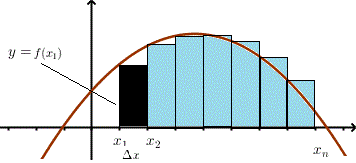
Nous pouvons approcher l'aire sous la courbe de \( x = x_1 \) à \( x = x_n \) en divisant l'aire totale en rectangles.
Par exemple, l'aire du premier rectangle est donnée par :
\[ y \Delta x = f(x_1)\Delta x \]L'addition des aires de ces rectangles donne :
\[ \text{Aire approchée} = \sum_{i=1}^{n-1} f(x_i)\Delta x \]Si \( \Delta x \) dans l'approximation ci-dessus devient suffisamment petit, la somme des aires des rectangles approchera la valeur exacte de l'aire sous la courbe.
Par conséquent, nous définissons l'aire exacte à l'aide d'une limite :
\[ \text{Aire exacte} = \lim_{\Delta x \to 0} \sum_{i=1}^{n-1} f(x_i)\Delta x \]En utilisant le concept d'intégrales définies, cette limite est notée ainsi :
Nous présentons maintenant plusieurs exemples sur la manière d'utiliser les intégrales pour trouver l'aire sous une courbe, accompagnés de solutions détaillées.
Exemples avec solutions détaillées
Exemple 1
Trouvez l'aire de la région délimitée par \( y = 2x \), \( y = 0 \), \( x = 0 \) et \( x = 2 \).
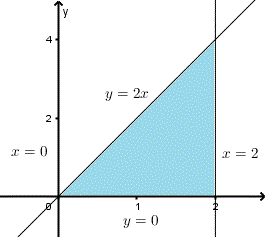
Solution de l'exemple 1
Méthode 1 : Formule géométrique de l'aire d'un triangle
\[ \text{Aire} = \frac{1}{2} \times \text{base} \times \text{hauteur} = \frac{1}{2} \times 2 \times 4 = 4 \; \text{unité}^2 \]Méthode 2 : Utilisation du calcul (intégrales définies)
Soit \( f(x) = 2x \) :
\[ \text{Aire} = \int_{0}^{2} (2x) \, dx = 2 \int_{0}^{2} x \, dx = 2 \left[ \frac{x^2}{2} \right]_0^2 = 4 \; \text{unité}^2 \]La première méthode est rapide pour les triangles, mais le calcul fonctionne pour des courbes arbitraires.
Exemple 2
Trouvez l'aire de la région délimitée par \( y = 0.1x^3 \), \( y = 0 \), \( x = 2 \) et \( x = 4 \).
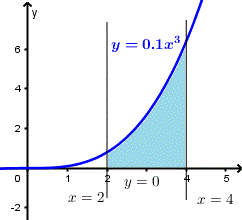
Solution de l'exemple 2
Utilisons des intégrales définies pour trouver l'aire :
\[ \begin{aligned} \text{Aire} &= \int_{2}^{4} (0.1x^3)\,dx \\ &= 0.1 \int_{2}^{4} x^3\,dx \\ &= 0.1 \left[ \frac{x^4}{4} \right]_2^4 \\ &= 0.1 \left( \frac{4^4}{4} - \frac{2^4}{4} \right) = 6 \; \text{unité}^2 \end{aligned} \]Exemple 3
Trouvez l'aire de la région finie délimitée par la courbe \( y = 3(x - 1)(x - 3) \) et l'axe des x.

Solution de l'exemple 3
Les limites d'intégration sont les intersections avec l'axe des x, qui sont clairement \( x = 1 \) et \( x = 3 \) d'après la forme factorisée.
\[ \begin{aligned} \int_{1}^{3} 3(x - 1)(x - 3)\,dx &= 3 \int_{1}^{3} (x^2 - 4x + 3)\,dx \\ &= 3 \left[ \frac{x^3}{3} - 2x^2 + 3x \right]_1^3 \\ &= 3 \left[ (9 - 18 + 9) - (\frac{1}{3} - 2 + 3) \right] = -4 \end{aligned} \]Notez que l'intégrale définie est négative parce que la courbe est sous l'axe des x entre \( x = 1 \) et \( x = 3 \). L'aire réelle est la valeur absolue : \( |-4| = 4 \; \text{unité}^2 \).
Exemple 4
Trouvez l'aire de la région finie délimitée par la courbe \( y = -0.25x(x + 2)(x - 1)(x - 4) \) et l'axe des x.

Solution de l'exemple 4
Les intersections avec l'axe des x sont \( x = -2 \), \( x = 1 \) et \( x = 4 \). La région est divisée en trois parties : de \( -2 \) à \( 0 \), de \( 0 \) à \( 1 \), et de \( 1 \) à \( 4 \).
Région 1 (\( [-2, 0] \)) :
\[ I_1 = -0.25 \int_{-2}^{0} (x^4 - 3x^3 - 6x^2 + 8x) \, dx = 3.4 \]Région 2 (\( [0, 1] \)) :
\[ I_2 = -0.25 \int_{0}^{1} (x^4 - 3x^3 - 6x^2 + 8x) \, dx = -0.3625 \]Région 3 (\( [1, 4] \)) :
\[ I_3 = -0.25 \int_{1}^{4} (x^4 - 3x^3 - 6x^2 + 8x) \, dx = 13.1625 \]En prenant la valeur absolue des régions négatives, l'aire totale est :
\[ \text{Aire} = I_1 + |I_2| + I_3 = 3.4 + |-0.3625| + 13.1625 = 16.925 \; \text{unité}^2 \]Exemple 5
Trouvez \( k \) de sorte que l'aire de la région finie délimitée par \( y = -x(x - k) \) et l'axe des x soit égale à \( 4/3 \) unité\(^2\).

Solution de l'exemple 5
Les intersections sont en \( x = 0 \) et \( x = k \) :
\[ \text{Aire} = \int_{0}^{k} (-x^2 + kx) \, dx = \left[ -\frac{x^3}{3} + \frac{kx^2}{2} \right]_{0}^{k} = \frac{k^3}{6} \]En posant cette valeur égale à \( 4/3 \) :
\[ \frac{k^3}{6} = \frac{4}{3} \implies k^3 = 8 \implies k = 2 \]Exercices
- Trouvez l'aire de la région finie délimitée par \( y = -(x + 1)(x - 3) \) et \( y = 0 \).
- Trouvez l'aire de la région finie délimitée par \( y = \sin(x) \), \( y = 0 \), \( x = 0 \) et \( x = 2\pi \).
- Trouvez \( k > 0 \) de sorte que l'aire sous la courbe \( y = x + 2 \) entre les axes verticaux \( x = 0 \), \( x = k \) et l'axe des x soit égale à \( 2 \).
Réponses aux exercices ci-dessus
- \( \dfrac{32}{3} \)
- \( 4 \)
- \( k = 2\sqrt{2} - 2 \)