Question 1
Solve the following systems of equations:
a) \( \begin{cases} -2(x - 2) + (-y - 3) = 3 \\ 2(x + 3) - 3(y - 2) = 10 \end{cases} \)
b) \( \begin{cases} \dfrac{x - 1}{3} + y = 5 \\ 2(x + 3) - \dfrac{y}{5} = 7 \end{cases} \)
c) \( \begin{cases} (x - 1)^2 + y = -1 \\ -4x + 2y = -6 \end{cases} \)
Click to see Solution to Question 1
Solution a: Expand the left sides: \( -2x+4-y-3=3 \rightarrow -2x-y=2 \) (Eq. I) and \( 2x+6-3y+6=10 \rightarrow 2x-3y=-2 \) (Eq. II). Add (I) and (II) to eliminate \( x \): \( (-2x-y) + (2x-3y) = 2 + (-2) \rightarrow -4y = 0 \rightarrow y = 0 \). Substitute \( y=0 \) into (I): \( -2x-0=2 \rightarrow x = -1 \). Final Answer: (-1, 0).
Solution b: Multiply the first equation by 3 and the second by 5: \( x-1+3y=15 \rightarrow x+3y=16 \) (I) and \( 10(x+3)-y=35 \rightarrow 10x-y=5 \) (II). Multiply (II) by 3: \( 30x-3y=15 \). Add to (I): \( 31x=31 \rightarrow x=1 \). Substitute: \( 1+3y=16 \rightarrow 3y=15 \rightarrow y=5 \). Final Answer: (1, 5).
Solution c: Solve (II) for \( y \): \( 2y = 4x-6 \rightarrow y = 2x-3 \). Substitute into (I): \( (x-1)^2 + (2x-3) = -1 \rightarrow x^2-2x+1+2x-3 = -1 \rightarrow x^2-1=0 \). Thus \( x = 1 \) or \( x = -1 \). For \( x=1, y=-1 \). For \( x=-1, y=-5 \). Final Answer: (1, -1) and (-1, -5).
Question 2
Expand and simplify the following algebraic expressions:
a) \( -(x + 2)(x - 1) + (x - 2)^2 \)
b) \( (x - 2)(x^2 + 3x - 3) - (x - 1)(x + 1) \)
Click to see Solution to Question 2
Solution a: First, expand the products: \( (x+2)(x-1) = x^2+x-2 \) and \( (x-2)^2 = x^2-4x+4 \). Apply the negative sign: \( -(x^2+x-2) = -x^2-x+2 \). Combine: \( (-x^2-x+2) + (x^2-4x+4) = -5x+6 \). Final Answer: -5x+6.
Solution b: Expand the cubic product: \( x(x^2+3x-3) - 2(x^2+3x-3) = x^3+3x^2-3x - 2x^2-6x+6 = x^3+x^2-9x+6 \). Expand the difference of squares: \( (x-1)(x+1) = x^2-1 \). Combine: \( (x^3+x^2-9x+6) - (x^2-1) = x^3+x^2-9x+6-x^2+1 = x^3-9x+7 \). Final Answer: x³-9x+7.
Question 3
Factor the following expressions completely:
a) \( 3x^3 + 6x^2 \)
b) \( (x - 3)(x^2 + 3x + 2) - (x - 3)(x + 1) \)
c) \( 81x^2 - 16y^2 \)
d) \( -6x^2 + 7x - 2 \)
Click to see Solution to Question 3
Solution a: Identify the GCF: \( 3 \) and \( x^2 \). Factored form: 3x²(x + 2).
Solution b: Factor out the common binomial \( (x-3) \): \( (x-3)[(x^2+3x+2) - (x+1)] = (x-3)(x^2+2x+1) \). Recognizing the perfect square trinomial \( a^2+2ab+b^2 = (a+b)^2 \), we get: (x - 3)(x + 1)².
Solution c: Use the Difference of Squares formula \( a^2 - b^2 = (a-b)(a+b) \). Here \( a=9x \) and \( b=4y \). Final Answer: (9x - 4y)(9x + 4y).
Solution d: Factor out -1: \( -(6x^2-7x+2) \). Using the AC method where \( a \cdot c = 12 \) and \( b = -7 \), the numbers are -3 and -4. Factoring gives: -(2x - 1)(3x - 2).
Question 4
Given the quadratic function \( f(x) = -2x^2 - 2x + 4 \), determine:
a) The vertex coordinates using the completing the square method.
b) The x-intercepts (where \( f(x)=0 \)) and the y-intercept (where \( x=0 \)).
c) The equation of the axis of symmetry.
d) Check your results by analyzing the graph.
Click to see Solution to Question 4
Solution a: Factor -2 from x-terms: \( -2(x^2+x)+4 \). Add and subtract \( (1/2)^2 = 1/4 \) inside: \( -2[(x+1/2)^2 - 1/4] + 4 = -2(x+1/2)^2 + 1/2 + 4 \). Vertex Form: \( f(x) = -2(x+0.5)^2 + 4.5 \). Vertex: (-0.5, 4.5).
Solution b: \( y \)-intercept: \( f(0) = \mathbf{4} \). For \( x \)-intercepts, solve \( -2x^2-2x+4=0 \rightarrow -2(x^2+x-2)=0 \rightarrow -2(x+2)(x-1)=0 \). Intercepts: x = 1, x = -2.
Solution c: The axis of symmetry is the vertical line through the vertex \( x = h \). Final Answer: x = -0.5.

Question 5
Using the principles of direct and inverse proportionality, determine the missing values in the tables below where possible.

Click to see Solution to Question 5
Table a: Test the ratio \( y/x \): \( 1.8/0.3 = 6, 4.2/0.7 = 6 \). This is direct proportion with formula \( y = 6x \). For \( x=0.2, y = 6(0.2) = \mathbf{1.2} \).
Table b: Test the product \( xy \): \( 0.1 \cdot 2 = 0.2, 0.5 \cdot 0.4 = 0.2 \). This is inverse proportion with formula \( xy = 0.2 \). For \( x=20, y = 0.2/20 = \mathbf{0.01} \).
Table c: The ratios and products are not constant. Therefore, no specific proportionality rule can be established to find the missing value.
Question 6
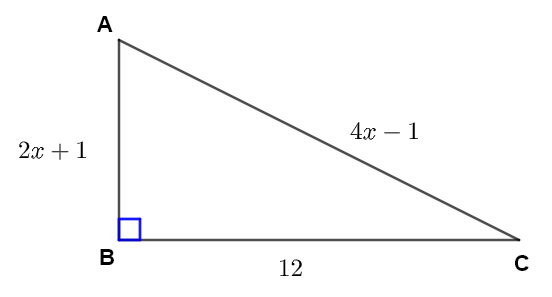
Find the values of \( x \), all unknown side lengths, and the measures of all angles in the right triangle provided below.
Click to see Solution to Question 6
Apply the Pythagorean Theorem: \( a^2 + b^2 = c^2 \).
\( (2x+1)^2 + 12^2 = (4x-1)^2 \)
\( (4x^2 + 4x + 1) + 144 = 16x^2 - 8x + 1 \)
\( 12x^2 - 12x - 144 = 0 \). Divide by 12: \( x^2 - x - 12 = 0 \).
Factoring gives \( (x-4)(x+3) = 0 \). Since length must be positive, x = 4.
Sides: \( \overline{AB}=2(4)+1=9 \), \( \overline{BC}=12 \), \( \overline{AC}=4(4)-1=15 \).
Angles: \( \angle C = \tan^{-1}(9/12) \approx \mathbf{36.87^\circ} \). \( \angle A = 90 - 36.87 = \mathbf{53.13^\circ} \).
Question 7
Angle \( \alpha \) is an acute angle in a right triangle such that the sine of the angle is \( \sin \alpha = 0.6 \). Determine the values of \( \cos \alpha \) and \( \tan \alpha \).
Click to see Solution to Question 7
Using the Pythagorean Identity: \( \sin^2 \alpha + \cos^2 \alpha = 1 \).
Substitute the given value: \( (0.6)^2 + \cos^2 \alpha = 1 \)
\( 0.36 + \cos^2 \alpha = 1 \rightarrow \cos^2 \alpha = 0.64 \).
Since \( \alpha \) is acute, we take the positive root: \( \cos \alpha = 0.8 \).
Using the identity \( \tan \alpha = \frac{\sin \alpha}{\cos \alpha} \):
\( \tan \alpha = \frac{0.6}{0.8} = \mathbf{0.75} \).
Question 8
In the figure below, segment BE is parallel to segment CD (\( BE \parallel CD \)). Calculate the unknown lengths \( x \) (segment CD) and \( y \) (segment DE).

Click to see Solution to Question 8
Because \( BE \parallel CD \), triangles \( ABE \) and \( ACD \) are similar (\( \triangle ABE \sim \triangle ACD \)) by AA Similarity.
Find x: \( \frac{AB}{AC} = \frac{BE}{CD} \rightarrow \frac{10}{10+2} = \frac{6}{x} \rightarrow 10x = 72 \rightarrow \mathbf{x = 7.2} \).
Find y: \( \frac{AE}{AD} = \frac{EB}{DC} \rightarrow \frac{11}{11+y} = \frac{6}{7.2} \).
\( 6(11+y) = 79.2 \rightarrow 66 + 6y = 79.2 \rightarrow 6y = 13.2 \rightarrow \mathbf{y = 2.2} \).
Question 9
In a triangle ABC, the lengths of side AB (\( c \)) and side BC (\( a \)) are 14 cm and 10 cm respectively. The measure of angle C is \( 49^\circ \). Find all unknown angles and the remaining unknown side of the triangle.
Click to see Solution to Question 9
Apply the Sine Law: \( \frac{a}{\sin A} = \frac{c}{\sin C} \).
\( \frac{10}{\sin A} = \frac{14}{\sin 49^\circ} \rightarrow \sin A = \frac{10 \cdot \sin 49^\circ}{14} \approx 0.539 \).
\( A = \sin^{-1}(0.539) \approx \mathbf{32.62^\circ} \).
Find angle B: \( B = 180^\circ - (49^\circ + 32.62^\circ) = \mathbf{98.38^\circ} \).
Find side \( b \): \( \frac{b}{\sin 98.38^\circ} = \frac{14}{\sin 49^\circ} \rightarrow b = \frac{14 \cdot \sin 98.38^\circ}{\sin 49^\circ} \approx \mathbf{18.35 \text{ cm}} \).
Question 10
Determine the specific values for constants \( A \) and \( B \) in the linear equation \( Ax + By = 1 \) if the line passes through the point \( (1, 5) \) and has a y-intercept at \( y = 3 \).
Click to see Solution to Question 10
1. The y-intercept is at \( (0, 3) \). Substitute into the equation: \( A(0) + B(3) = 1 \rightarrow 3B = 1 \rightarrow \mathbf{B = 1/3} \).
2. The line passes through \( (1, 5) \). Substitute \( x=1, y=5, B=1/3 \):
\( A(1) + (1/3)(5) = 1 \rightarrow A + 5/3 = 1 \).
\( A = 1 - 5/3 = \mathbf{-2/3} \).
Question 11
A chemist needs to create 5 Liters of a 45% sulfuric acid solution. He has a 20% solution and a 55% solution available. How many liters of each must be mixed to achieve the desired concentration?
Click to see Solution to Question 11
Let \( x \) = volume of 20% solution and \( y \) = volume of 55% solution.
Equation 1 (Total Volume): \( x + y = 5 \)
Equation 2 (Acid Content): \( 0.20x + 0.55y = 0.45(5) \rightarrow 0.20x + 0.55y = 2.25 \).
Multiply Eq. 1 by 0.20: \( 0.20x + 0.20y = 1.0 \).
Subtract from Eq. 2: \( 0.35y = 1.25 \rightarrow \mathbf{y \approx 3.58 \text{ L}} \).
Substitute back: \( x = 5 - 3.58 = \mathbf{1.42 \text{ L}} \).
Question 12
A family traveled 1000 km from Paris to Prague in exactly 10 hours. Part of the trip was driven at an average speed of 80 km/h and the remainder at 120 km/h. Calculate the distance driven at each respective speed.
Click to see Solution to Question 12
Let \( x \) = distance at 80 km/h and \( y \) = distance at 120 km/h.
Using the formula \( \text{Time} = \frac{\text{Distance}}{\text{Speed}} \):
Eq 1 (Total Distance): \( x + y = 1000 \)
Eq 2 (Total Time): \( \frac{x}{80} + \frac{y}{120} = 10 \).
Multiply Eq 2 by 240 (LCD): \( 3x + 2y = 2400 \).
From Eq 1, \( y = 1000 - x \). Substitute into the simplified Eq 2:
\( 3x + 2(1000 - x) = 2400 \rightarrow 3x + 2000 - 2x = 2400 \).
x = 400 km at 80 km/h, and y = 600 km at 120 km/h.
Question 13
Triangle ABC has vertices \( A(2, 3) \) and \( B(-3, 4) \). Vertex \( C \) is located somewhere on the vertical line \( x = -1 \). Determine the y-coordinate of point \( C \) such that triangle ABC is a right triangle with hypotenuse \( AC \).
Click to see Solution to Question 13
Let \( C = (-1, b) \). For \( AC \) to be the hypotenuse, the right angle must be at vertex \( B \). By Pythagoras: \( AC^2 = AB^2 + BC^2 \).
Distance Squared Formula: \( d^2 = (x_2-x_1)^2 + (y_2-y_1)^2 \).
\( AB^2 = (2 - (-3))^2 + (3 - 4)^2 = 25 + 1 = 26 \).
\( BC^2 = (-3 - (-1))^2 + (4 - b)^2 = 4 + (4 - b)^2 \).
\( AC^2 = (2 - (-1))^2 + (3 - b)^2 = 9 + (3 - b)^2 \).
Set up equation: \( 9 + (3 - b)^2 = 26 + 4 + (4 - b)^2 \).
\( 9 + 9 - 6b + b^2 = 30 + 16 - 8b + b^2 \).
\( 18 - 6b = 46 - 8b \rightarrow 2b = 28 \rightarrow \mathbf{b = 14} \). Final coordinate: (-1, 14).
Question 14
Linda's budget analysis shows that 5% of her monthly budget is 200. She spends \( 70\% \) of her total budget on housing and food. If she spends $500 more on housing than on food, calculate the specific amount spent on each.
Click to see Solution to Question 14
1. Find the Total Budget (\(B\)):
Since 5% of the budget is $200, we write the equation:
\( 0.05 \cdot B = 200 \)
\( B = \frac{200}{0.05} \)
\( B = \$4,000 \)
2. Determine the combined total for Housing (\(h\)) and Food (\(f\)):
These categories make up 70% of the budget:
\( h + f = 0.70 \cdot 4000 \)
\( h + f = \$2,800 \) — (Equation I)
3. Relate Housing to Food:
Housing is $500 more than food:
\( h = f + 500 \) — (Equation II)
4. Solve the system of equations:
Substitute Equation II into Equation I:
\( (f + 500) + f = 2800 \)
\( 2f + 500 = 2800 \)
\( 2f = 2300 \)
\( f = \$1,150 \)
5. Find Housing cost:
\( h = 1150 + 500 \)
\( h = \$1,650 \)
Final Answer: Linda spends $1,650 on housing and $1,150 on food.
Question 15
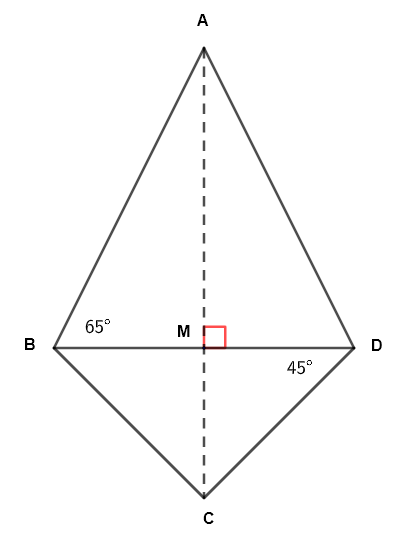
Find the total area of the kite shown below, given that the length of segment CD is 10 cm.
Click to see Solution to Question 15
Formula for Kite Area: \( \text{Area} = \frac{\overline{AC} \cdot \overline{BD}}{2} \).
In right triangle \( DMC \), \( \angle MDC = 45^\circ \), so it is isosceles. \( \overline{DM} = \overline{MC} \).
\( \overline{DM}^2 + \overline{MC}^2 = 10^2 \rightarrow 2\overline{DM}^2 = 100 \rightarrow \overline{DM} = \sqrt{50} = 5\sqrt{2} \).
Diagonal 1 (\( \overline{BD} \)) = \( 2 \cdot 5\sqrt{2} = 10\sqrt{2} \).
Diagonal 2 (\( \overline{AC} \)) = \( \overline{AM} + \overline{MC} \). \( \overline{AM} = 5\sqrt{2} \cdot \tan(65^\circ) \approx 15.15 \).
\( \overline{AC} = 15.15 + 7.07 = 22.22 \).
Area: \( \frac{22.22 \cdot 14.14}{2} \approx \mathbf{157.23 \text{ cm}^2} \).
Question 16
Given that lines \( m \) and \( n \) are parallel, prove that lines \( m \) and \( r \) are perpendicular based on the intersecting angles shown in the diagram.

Click to see Solution to Question 16
1. Let the transversal angle on line \( n \) be \( \alpha = 33^\circ \). Since \( m \parallel n \), the Corresponding Angle \( \beta \) on line \( m \) is also \( 33^\circ \).
2. Within the triangle formed by the intersections, the sum of angles must be \( 180^\circ \). The known angles are \( 89^\circ \) and \( 34^\circ \). The third angle \( \theta = 180 - (89 + 34) = \mathbf{57^\circ} \).
3. The total angle between line \( m \) and line \( r \) is the sum of the adjacent angles \( \beta \) and \( \theta \):
\( \text{Total Angle} = 33^\circ + 57^\circ = \mathbf{90^\circ} \).
Since the angle is \( 90^\circ \), lines \( m \) and \( r \) are perpendicular.
Question 17
Calculate the vertical height AM of a right square pyramid. Its volume is given as 1500 cm³, and the base diagonal CE measures 10 cm.

Click to see Solution to Question 17
Volume of a Pyramid: \( V = \frac{1}{3} \cdot \text{Base Area} \cdot h \).
Let the square base side be \( s \). Diagonal \( d = s\sqrt{2} \rightarrow 10 = s\sqrt{2} \rightarrow s^2 = 50 \) (Base Area).
Substitute values: \( 1500 = \frac{1}{3} \cdot 50 \cdot h \).
\( 4500 = 50h \rightarrow \mathbf{h = 90 \text{ cm}} \).