Rational Functions: Domain, Intercepts, Asymptotes & Holes
This lesson introduces rational functions and the main properties of their graphs, including the domain, x- and y-intercepts, and vertical, horizontal, and slant asymptotes. Worked examples and interactive resources are included to reinforce understanding.
Definition and Domain of Rational Functions
A rational function is defined as the quotient of two polynomial functions:
\[ f(x) = \frac{P(x)}{Q(x)} \]The graph below represents the function
\[ f(x) = \frac{x^2 - 1}{(x + 2)(x - 3)} \]Since the denominator equals zero at \(x = -2\) and \(x = 3\), the function is undefined at these values. As a result, the graph is discontinuous there. The dashed vertical lines indicate values where the function is undefined and foreshadow the concept of vertical asymptotes.

Because division by zero is undefined, the domain of a rational function consists of all real numbers except those that make the denominator equal to zero.
Example 1: Finding the Domain
Find the domain of each function:
- \( f(x) = \frac{x + 2}{x} \)
- \( g(x) = \frac{x - 1}{x - 2} \)
- \( h(x) = \frac{x}{(x - 1)(x + 5)} \)
- \( k(x) = \frac{x^2 - 1}{x^2 - 9} \)
- \( l(x) = \frac{x^2 - 1}{x^2 + 1} \)
View Solutions to Example 1
- The denominator must not be zero: \[ x \neq 0 \] Domain: \( (-\infty, 0) \cup (0, +\infty) \)
- Solve \(x - 2 = 0\): \[ x = 2 \] Domain: \( (-\infty, 2) \cup (2, +\infty) \)
- Solve \((x - 1)(x + 5) = 0\): \[ x = 1,\; x = -5 \] Domain: \( (-\infty, -5) \cup (-5, 1) \cup (1, +\infty) \)
- Solve \(x^2 - 9 = 0\): \[ x = \pm 3 \] Domain: \( (-\infty, -3) \cup (-3, 3) \cup (3, +\infty) \)
-
Since \(x^2 + 1 \neq 0\) for all real \(x\) (it is always positive), the domain is all real numbers.
Domain: \( (-\infty, +\infty) \)
Holes in the Graphs of Rational Functions
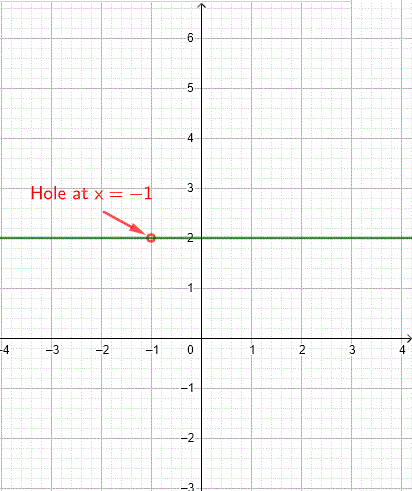
A hole (or removable discontinuity) occurs when the numerator and denominator share a common factor, and cancelling this factor does not leave a zero in the denominator at that specific point.
Example 2: Hole in a Rational Function
Identify any holes in the graph of the function:
\[ f(x) = \frac{2x + 2}{x + 1} \]View Solution
Factor the numerator:
\[ f(x) = \frac{2(x + 1)}{x + 1} = 2, \quad \text{provided } x \neq -1 \]Because the \((x+1)\) factor cancels out, the function behaves exactly like the horizontal line \(y = 2\) everywhere except at \(x = -1\). At \(x = -1\), the original function is undefined, creating a hole at the point \((-1, 2)\).
Vertical Asymptotes of Rational Functions
Consider the basic reciprocal function:
\[ f(x) = \frac{1}{x} \]The function is undefined at \(x = 0\). As \(x\) approaches zero from the right and left, the function values grow without bound:
\[ \lim_{x \to 0^+} f(x) = +\infty, \qquad \lim_{x \to 0^-} f(x) = -\infty \]The vertical line \(x = 0\) is a vertical asymptote. In general, vertical asymptotes occur at zeros of the denominator that do not completely cancel with factors in the numerator.
Example 3: Vertical Asymptotes
Find the vertical asymptotes (if any) for the following functions:
- \( f(x) = \frac{1}{x - 2} \)
- \( g(x) = \frac{x - 1}{x^2 - 1} \)
- \( h(x) = \frac{6}{x^2 + 2} \)
View Solutions to Example 3
- Set the denominator to zero: \(x - 2 = 0 \Rightarrow x = 2\). Since the numerator is non-zero at \(x=2\), the line \(x = 2\) is a vertical asymptote.
- Factor the denominator: \[ g(x) = \frac{x - 1}{(x - 1)(x + 1)} = \frac{1}{x + 1}, \quad x \neq 1 \] Because the \((x-1)\) factor cancels, there is a hole at \(x = 1\). The remaining factor in the denominator gives a vertical asymptote at \(x = -1\).
- Set the denominator to zero: \(x^2 + 2 = 0\). Since \(x^2 \ge 0\), \(x^2 + 2\) is never zero for any real number. Therefore, there are no vertical asymptotes.

Horizontal Asymptotes of Rational Functions
As \(|x|\) becomes very large, the graph of \(f(x) = \frac{1}{x}\) approaches the horizontal line:
\[ y = 0 \]This behavior is described using limits at infinity:
\[ \lim_{x \to +\infty} \frac{1}{x} = 0, \qquad \lim_{x \to -\infty} \frac{1}{x} = 0 \]Rules for Horizontal Asymptotes
Let \(f(x) = \frac{P(x)}{Q(x)}\) be a rational function, where \(P(x)\) is the numerator polynomial and \(Q(x)\) is the denominator polynomial.
- If \(\deg P < \deg Q\): The horizontal asymptote is the x-axis, \(y = 0\).
- If \(\deg P = \deg Q\): The horizontal asymptote is the line \(y = \frac{a}{b}\), where \(a\) and \(b\) are the leading coefficients of \(P(x)\) and \(Q(x)\), respectively.
- If \(\deg P > \deg Q\): The graph has no horizontal asymptote.
Example 4: Horizontal Asymptotes
Find the horizontal asymptote (if any) for each function:
- \( f(x) = \frac{3x - 1}{x + 2} \)
- \( g(x) = \frac{x^2 + 4}{2x^3 - 1} \)
- \( h(x) = \frac{x^3 - 2x}{x + 1} \)
View Solutions to Example 4
- The numerator and denominator have the same degree (1). The leading coefficients are \(a = 3\) and \(b = 1\), so the horizontal asymptote is \(y = 3\).
- The degree of the numerator (2) is less than the degree of the denominator (3), so the horizontal asymptote is \(y = 0\).
- The degree of the numerator (3) is greater than the degree of the denominator (1), so there is no horizontal asymptote.
Slant Asymptotes of Rational Functions
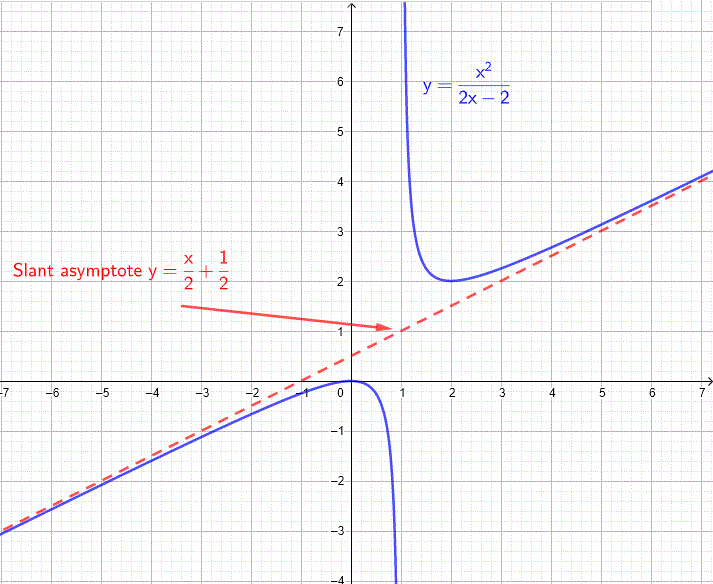
If the degree of the numerator is exactly one more than the degree of the denominator (\(\deg P = \deg Q + 1\)), the graph has a slant (or oblique) asymptote. You find it by performing polynomial long division.
Example 5: Slant Asymptote
Find the slant asymptote for the function:
\[ h(x) = \frac{x^2}{2x - 2} \]View Solution
Because the degree of the numerator (2) is exactly one more than the degree of the denominator (1), there is a slant asymptote. Use polynomial division to divide \(x^2\) by \(2x - 2\):
\[ \frac{x^2}{2x - 2} = \frac{x}{2} + \frac{1}{2} + \frac{1}{2x - 2} \]As \(x \to \pm\infty\), the remainder term \(\frac{1}{2x - 2}\) approaches 0. Therefore, the graph approaches the line represented by the quotient.
The slant asymptote is the line:
\[ y = \frac{x}{2} + \frac{1}{2} \]